Rescue Your Strategy from OKR Implementation Fail: An HR Guide
OKR Implementation Fail

Your strategic goals are a secret. And your team has stopped trying to decode them.
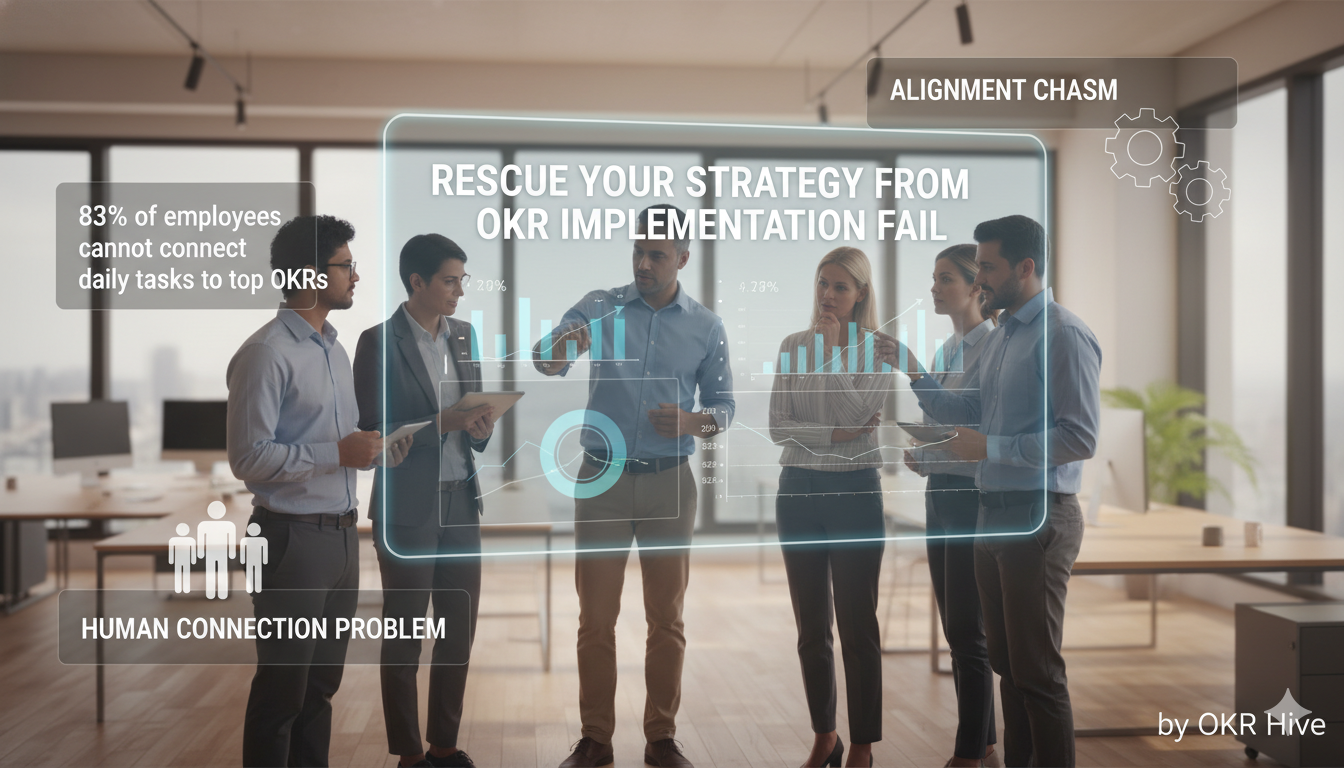
Why? Because 83% of employees cannot connect their daily tasks to the company's top OKRs. They are executing blind.
This alignment chasm is the epicenter of every OKR implementation fail. Organizations invest in the framework, only to harvest disengagement and confusion.
Rescue Your Strategy from OKR Implementation Fail: An HR Guide
The ambitious vision set by leadership never translates into actionable meaning for the teams doing the work.
This isn't a strategy problem, it's a human connection problem, an HR perspective on OKR failure. We see the fallout: a disconnected workforce and a culture adrift.
We're exposing the real reasons behind this OKR adoption failure.
This is your definitive guide to closing the gap, with essential HR insights on OKR adoption failure.
Stop the cycle. Create alignment that actually works and prevent OKR process failure.
The Silent Saboteurs: Unmasking the Real Causes of OKR Failure
Most organizations blame the tool when their OKRs don't work. The truth is more nuanced. An OKR adoption failure is typically a symptom of deeper organizational issues.
Here are the most common culprits HR professionals identify.
1. Treating OKRs as a Secret Management Tool
A surefire path to an OKR implementation fail is keeping goals locked in a spreadsheet or a private executive dashboard.
When OKRs are a top-down secret, they create zero buy-in. Employees see them as another corporate mandate, not a shared compass. This lack of transparency is a primary OKR pitfall.
HR insights on OKR failure show that transparency builds trust and alignment. When everyone can see the company's North Star and how their work contributes, magic happens.
2. The "Set and Forget" Trap
Many teams spend days crafting perfect OKRs. Then, they file them away until the next quarter. This is a critical OKR process failure.
OKRs are meant to be living, breathing entities. They require weekly check-ins, progress updates, and honest conversations about what’s working and what’s not. Without this rhythm, OKR performance failure is guaranteed.
How HR teams handle OKR implementation fail is by embedding these check-ins into the natural workflow, not adding them as extra meetings.
3. Confusing OKRs with KPIs and To-Do Lists
This is perhaps the most common of all common OKR errors.
Key Performance Indicators (KPIs) are health metrics for your business-as-usual activities.
OKRs are about ambitious, measurable change and growth.
If your "Objective" is "Improve Customer Support" and your Key Result is "Maintain a 95% Satisfaction Score," you've just described a KPI. An OKR would be more like: "Revolutionize the Customer Support Experience" with a Key Result of "Reduce first-response time by 50%."
Mixing these up leads to stagnant goals and missed innovation opportunities.
4. A Culture That Punishes Ambition
The "A" in OKR stands for "Aspirational." These are goals that feel slightly out of reach, aiming for 70% completion as a sign of stretching.
However, in many companies, scoring a 0.7 on an OKR is seen as... failure. This mindset is toxic. It encourages teams to set safe, easily achievable goals. This fear of falling short is a core reason for OKR adoption failure.
Preventing OKR mistakes according to HR experts requires a fundamental shift in how we view performance and ambition.
Real-World OKR Implementation Fail Examples from HR
Let's make this concrete. Here are two anonymized cases from our HR network.
Case Study 1: The Siloed Software Company
A tech startup implemented OKRs with great fanfare. Each department head created their own.
The engineering team aimed for "Ship 5 New Features." The sales team aimed to "Increase Revenue by 20%." The marketing team aimed to "Generate 1,000 New Leads."
On the surface, these seem fine. But they were created in isolation. The new features engineering shipped weren't the ones sales needed to close deals. Marketing's leads weren't a good fit for the new product capabilities.
The result? An OKR rollout failure. Departments "succeeded" individually, but the company missed its overall growth target.
The organizational challenges in OKR implementation fail were clear: siloed thinking and a lack of company-wide alignment.
Case Study 2: The Perfectionist Consulting Firm
A professional services firm demanded that every OKR be perfectly quantifiable from day one. Teams spent weeks in planning paralysis, arguing over the exact metrics. The pressure to be perfect killed all creativity and ambition.
The OKRs that emerged were bland and operational. The firm avoided an OKR performance failure because the goals were so easy to hit.
But they gained zero competitive advantage. They had successfully used OKRs to document business-as-usual.
This is a subtle but devastating OKR process failure. They were technically doing OKRs, but they missed the entire point.
The HR Playbook: Overcoming Common OKR Pitfalls
So, how do we fix this? HR is not just a bystander in this process. You are the architect of culture and process. Here are HR strategies to overcome OKR implementation fail.

The HR Playbook: Overcoming Common OKR Pitfalls
Strategy 1: Lead with "Why," Not "What"
Before you train anyone on how to write an OKR, explain why the company is adopting them.
Is it to improve focus? To increase alignment? To drive innovation?
Connect OKRs to the employee experience. Explain how this framework will make their work more meaningful, reduce wasted effort, and clarify priorities. This foundational communication is your first defense against common OKR adoption failures from an HR perspective.
Strategy 2: Invest in Real Training, Not Just a Memo
Don't assume people will "get it." A one-hour webinar is not enough. Provide robust, role-specific training.
For Leaders: Train them on cascading goals, fostering psychological safety, and leading effective check-ins.
For Managers: Teach them how to coach their teams in writing good OKRs and connecting team goals to company goals.
For Individual Contributors: Focus on how to create personal OKRs that align with team objectives and how to track progress.
This training is a critical investment in preventing OKR mistakes according to HR experts.
Strategy 3: Redefine Performance Management
Your annual performance review system can actively sabotage OKRs if it punishes employees for ambitious "stretch" goals that aren't fully achieved.
HR must decouple OKR scores from compensation and performance ratings. Make it explicit: "A score of 0.7 on a stretch goal is a success. We reward the effort and learning, not just the binary outcome."
This is a brave but necessary HR strategy for OKR success. It protects the aspirational nature of the framework.
Strategy 4: Champion Transparency and Tools
Make OKRs hyper-visible. Use a platform that everyone can access. When John in marketing can see what Priya in engineering is working on, collaboration happens naturally.
This visibility is key to how HR teams navigate OKR challenges—by preventing them before they start.
Strategy 5: Model the Behavior from the Top
The most important best practices from HR to avoid OKR implementation fail start at the top. The C-suite must have their own OKRs, share them publicly, and hold open, honest check-in meetings.
When employees see leadership embracing vulnerability by discussing their progress and challenges, it gives everyone else permission to do the same. HR's role is to coach executives on this behavior.
Building a Resilient OKR Process: A Practical Checklist
Ready to launch or relaunch your OKRs? Use this HR-informed checklist.
Secure executive sponsorship and have the CEO communicate the "why."
Decouple OKR scores from compensation and formal reviews.
Start with a pilot group of motivated teams before a full company rollout.
Provide dedicated, role-based training for everyone involved.
Implement a simple, transparent tool for tracking OKRs.
Establish a weekly or bi-weekly check-in rhythm.
Publicly celebrate ambitious "failures" and the lessons learned.
Assigning an HR or Operations lead to own and refine the process.
Following these steps addresses the root causes of OKR failure and builds a system for long-term success.
Conclusion: From Failure to Foundation
An OKR adoption failure is not a reflection of your company's potential. It is a signal that your process, culture, or understanding needs adjustment.
The journey to OKR mastery is iterative. You will make mistakes. The key is to learn from them quickly.
By embracing an HR perspective, you stop treating it as a software rollout and start treating it as a cultural transformation. You focus on the human elements: communication, psychological safety, and alignment.
This is how you turn a potential OKR implementation failure into your company's greatest strategic advantage.
Frequently Asked Questions (FAQs)
What is the single biggest sign of an impending OKR implementation failing?
The biggest red flag is silence. If no one is talking about OKRs after the initial launch, if they aren't a regular part of team meetings, and if leaders aren't referencing them, the process is already dying.
How can HR pinpoint why our OKRs fail?
Through anonymous surveys and focus groups. Ask targeted questions about goal alignment and psychological safety. How HR identifies causes of OKR failure is by analyzing this direct, honest feedback..
We've already failed once with OKRs. How can we relaunch without skepticism?
Be brutally honest. Acknowledge the previous failure publicly. Explain what you learned and, most importantly, outline the concrete changes you are making to the process, training, and culture this time around. Transparency builds credibility.
Should OKRs be tied to bonuses?
Almost universally, no. Tying OKRs directly to compensation incentivizes sandbagging, setting low, easily achievable goals to guarantee a bonus. It kills the "stretch" aspect that makes OKRs powerful. Keep them separate.
What's HR's most overlooked role in OKR success?
As guardians of psychological safety, HR ensures teams can aim high and sometimes miss without fear. This vulnerability fuels innovation, making it the ultimate HR strategy for OKR success.


