The Common OKR Mistakes That Are Quietly Demoralizing Your Team
Common OKR Mistakes
You've heard about OKRs. You know companies like Google and Intel use them to drive incredible growth. So, you roll them out to your team. But weeks later, nothing has changed. Goals are ignored, and frustration is high. What went wrong?
The problem isn't with OKRs themselves. The issue lies in how we set them up. Most teams stumble over the same hidden hurdles. In this guide, we will uncover the most common OKR mistakes that derail progress. More importantly, we will provide a clear path to fix them.

We are moving beyond basic theory. This is your practical, step-by-step guide to implementing OKRs successfully. You will learn the OKR best practices that separate the winners from the rest. Let's turn your goals from a source of stress into your engine for success.
Common OKR Mistakes (And How to Fix Them)
Many organizations treat OKRs like a simple to-do list. This is the first and biggest mistake. OKRs are a framework for strategic alignment and ambitious growth. Let's break down the key pitfalls. Understanding these common OKR mistakes is the first step toward building a high-performance culture.
Mistake #1: The "Set and Forget" Trap
This is perhaps the most frequent error. A team spends an afternoon crafting their OKRs. They post them in a shared document. And then… they forget about them until the next quarter. This turns OKRs into a pointless exercise.
Why it's a problem:
OKRs are meant to be a compass, not a monument. When you "set and forget," you lose all the benefits of focus and alignment. Your daily work quickly drifts away from your stated goals. This creates a disconnect that kills morale.
The Fix:
Schedule a weekly OKR check-in. This is a brief, 20-30 minute meeting. The only agenda is to review progress. Ask three simple questions:
What did we do last week to move our key results?
What are we planning to do this week?
What, if anything, is blocking our progress?
This rhythm keeps goals top-of-mind and allows for quick adjustments. It is one of the most critical OKR implementation tips for maintaining momentum.
Mistake #2: Confusing Tasks with Key Results
This mistake confuses activity with impact. Teams list their to-dos as Key Results (KRs) instead of measuring the outcome of that work.
Bad Key Result: "Launch the new marketing campaign." (This is a task.)
Good Key Result: "Generate 500 qualified leads from the new marketing campaign." (This is an outcome.)
Why it's a problem:
When you track tasks, you can complete everything on your list without making any real progress. You are busy, but not effective. You miss the opportunity to see if your work is actually moving the needle.
The Fix:
For every Key Result, ask "So what?".
"Launch the campaign." So what? "So we can generate more leads." Perfect. Your Key Result is "Generate 500 qualified leads." This shift from output to outcome is fundamental. It is a core part of how to implement OKR frameworks for true business impact and a key defense against common OKR mistakes.
Mistake #3: Sandbagging - The Fear of Ambition
Many teams are afraid to set ambitious goals. They worry about missing them and looking bad. So, they set goals they know they can easily achieve. This is called sandbagging. It completely defeats the purpose of OKRs.
Why it's a problem:
OKRs are designed to stretch your team. Ambitious goals inspire innovation and force creative thinking. A goal you are 100% sure you can hit is not an OKR; it's a task list. It does not drive growth.
The Fix:
Embrace the "70% rule." If you are confident you can achieve 100% of your OKRs, they are not ambitious enough. Aim for a confidence level of 70%. This means you are not quite sure how you will get there, but you believe it is possible. This is one of the most powerful OKR best practices for unlocking potential. It reframes a "failed" 70% score as a tremendous success.
Mistake #4: Too Many OKRs, Zero Focus
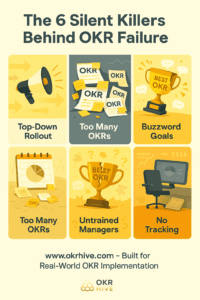
Ambition is good. Chaos is not. Some teams get excited and create a dozen Objectives with three Key Results each. This creates a scattered focus. Your team is suddenly pulled in twenty different directions. This overload is one of the most visible common OKR mistakes.
Why it's a problem:
As the saying goes, "If everything is a priority, nothing is." Too many OKRs dilute effort and energy. Your team cannot possibly focus on that many top-level goals. This leads to burnout and mediocre results across the board.
The Fix:
Less is more. A great rule of thumb is to set 3 to 5 Objectives per team, per quarter. Each Objective should have 2 to 4 Key Results. This forces you to have a ruthless conversation about what truly matters right now. This focus is the key to avoiding common pitfalls in OKR implementation.
Mistake #5: Treating OKRs as a Performance Review
This is a cultural killer. If managers use OKR achievement to determine bonuses or punish "failure," they have destroyed the system. Employees will immediately revert to sandbagging. They will never set a risky, ambitious goal again.
Why it's a problem:
It creates a culture of fear, not innovation. People will hide bad news and avoid challenging work. The OKR system becomes a game to be manipulated, not a tool for honest progress.
The Fix:
Decouple OKRs from performance reviews and compensation. Make this rule explicit and repeat it often. Celebrate the effort and learning from an ambitious attempt, even if the score was only 0.6. This psychological safety is the foundation for successful OKR implementation in organizations. Avoiding this punitive approach is critical to overcoming common OKR mistakes.
Your Step-by-Step Guide to Implementing OKRs Successfully
Now that you know what to avoid, let's build a winning strategy. This is your step-by-step guide to implementing OKRs successfully.
Step 1: Secure Leadership Buy-In
OKRs must start at the top. Leadership must not only approve but actively participate. They need to set the company-level OKRs and communicate why this is important. Without this, it is just another middle-management initiative.
Step 2: Train Everyone
Do not assume people understand OKRs. Host a workshop. Explain the "why," the structure (Objective = Inspire, Key Results = Measure), and the rules (ambition, transparency). Use examples from your own company.
Step 3: Set Company-Level OKRs First
The leadership team must set 3-5 high-level OKRs for the quarter. These become the North Star for the entire organization. Every team's OKRs should connect directly back to moving these company goals forward.
Step 4: Cascade to Teams
Now, each department (e.g., Marketing, Engineering) creates their own OKRs. They ask, "What can we do to help achieve the company's Objectives?" This creates alignment. Everyone can see how their work contributes to the bigger picture.
Step 5: Establish a Weekly Cadence
As we discussed, implement the weekly check-in. This is where the magic happens. It is the engine of accountability and progress. This simple habit is the difference between OKRs that work and OKRs that gather dust.
Step 6: Grade and Reflect
At the end of the quarter, hold a retrospective. Score each Key Result from 0.0 to 1.0. Discuss what worked and what did not. This reflection is not about blame. It is about learning and improving your process for the next cycle. This is how you master how to avoid common OKR mistakes in your business. A thorough review is your best defense against repeating the same common OKR mistakes.
The Secret Sauce: OKR Best Practices for Long-Term Success
Following the steps avoids disaster. Embracing these best practices creates excellence.
Radical Transparency: Make all OKRs visible to everyone in the company. This builds alignment and fosters collaboration.
Focus on Learning: Did an OKR fail? Analyze why. What did you learn about your market, your product, or your strategy? This learning is often more valuable than hitting an easy goal.
Keep it Simple: Use clear, jargon-free language. Anyone should be able to read your OKR and understand what you are trying to achieve.
Avoiding these common OKR mistakes is a continuous process. It requires discipline and a commitment to a new way of working. But the payoff is immense: a focused, aligned, and energized team that consistently achieves amazing things.
Are you ready to stop talking about goals and start achieving them?
Frequently Asked Questions (FAQs)
1. What is the ideal number of OKRs for a team?
For optimal focus, a team should have 3 to 5 Objectives per quarter. Each Objective should be supported by 2 to 4 measurable Key Results. This prevents teams from being spread too thin and is a key way to avoid common OKR mistakes related to lack of focus.
2. How often should we review our OKRs?
You should have a formal, weekly check-in to track progress and identify blockers. At the end of the quarter, you conduct a full grading and retrospective before setting new ones for the next cycle.
3. Should OKRs be tied to employee bonuses?
No. Tying OKRs directly to compensation encourages sandbagging (setting low-risk goals) and discourages ambitious, moonshot goals. OKRs should be a tool for alignment and growth, not performance evaluation.
4. What's a good score for an OKR?
A score of 0.7 to 1.0 (or 70% to 100%) is typically considered green and successful. Remember, OKRs are designed to be stretch goals. A score of 0.6 or 0.7 often indicates a perfectly ambitious goal that drove great effort and progress.
5. What's the difference between a Key Result and a task?
A Key Result is a measurable outcome. A task is an activity. For example, "Send 5 marketing emails" is a task. "Achieve a 15% open rate on our email campaign" is a Key Result. The Key Result measures the impact of the tasks.


