The Manager's Hack: How to Write OKRs That Impress Leadership.
Ever left a goal-setting meeting wondering, "What are we actually supposed to achieve?"
This frustration is universal. Teams spin their wheels, working hard but making little real progress. Vague goals create confusion, misalignment, and wasted effort. This lack of strategic clarity is the single biggest barrier to team performance.
The solution lies in mastering a clear framework for defining success. This practical guide will show you exactly how to write OKRs that eliminate ambiguity and create focus.
We’ll move beyond theory to give you an actionable manager’s blueprint for how to write OKRs that align your team and deliver measurable, impactful results. Let’s transform your goal-setting from a frustrating exercise into your greatest leadership advantage.
Why Your Current Goal-Setting Is Failing (And How OKRs Fix It)
Most team goal-setting fails for predictable reasons. Goals are often vague, like "improve customer satisfaction." They aren't measured, so no one knows if they're winning. They live in a document, never discussed again. This leads to misalignment and wasted effort.
The OKR framework solves this by creating a clear, measurable, and transparent structure for goals.
Objective: The inspirational, qualitative goal. It answers "Where do we want to go?"
Key Results: The quantitative, measurable outcomes. They answer "How will we know we've arrived?"
This simple OKR structure forces clarity. You can't hide behind fuzzy language. This guide on how to write OKRs will ensure your goals are ambitious, tracked, and shared by everyone.
The Manager's Mindset: Writing OKRs That Unlock Performance
Before we get to the steps, let's fix the mindset. How managers can write effective OKRs starts with a shift in perspective. You are not just assigning tasks. You are providing a clear direction and empowering your team to figure out the "how."
Your role is to create the container for ambition. This is the core of writing OKRs that improve team performance. You set the "What" and "Why," and your team helps define the "How." This creates ownership and accountability, moving you from a micromanager to a multiplier.
Step-by-Step Guide How to Write OKRs for Managers
Follow this process to build your OKRs from the ground up. This is the practical heart of how to write OKRs
Step 1: Define Your Objective (The Compass)
The Objective is your North Star. It should be short, inspirational, and easy to remember.
Best Practices for Writing Objectives:
Make it motivational. Use language that sparks energy. Instead of "Database Upgrade," try "Create a Blazing-Fast and Reliable Data Foundation."
Keep it qualitative. Avoid numbers here; save them for the Key Results.
Be clear and challenging. It should feel like a stretch, but not an impossibility.
Common OKR writing mistakes in this stage include creating a boring objective or one that is really a metric. "Increase Revenue by 20%" is a Key Result, not an Objective. The Objective would be "Become the Top-Revenue Generating Team in the Region."
Manager OKR examples for a Customer Support team:
Weak Objective: "Improve Support."
Strong Objective: "Deliver Five-Star, Effortless Customer Support Experiences."
Step 2: Craft Your Key Results (The Dashboard)
If the Objective is your compass, Key Results are your GPS coordinates. They are the specific, measurable benchmarks that prove you’ve achieved your Objective. This is where most OKR goal-setting mistakes happen.
How to create measurable Key Results:
Use specific metrics. Think percentages, counts, rates, or timeframes.
Set a baseline and a target. You need to know where you started.
Aim for 2-5 Key Results per Objective. Too few lack coverage; too many become unmanageable.
Let's build on our strong Customer Support Objective.
Objective: Deliver Five-Star, Effortless Customer Support Experiences.
Key Results:
Increase our Customer Satisfaction Score (CSAT) from 85% to 92%.
Reduce First Response Time from 4 hours to 1 hour.
Decrease customer contacts for "how-to" questions by 25% by improving help center content.
These Key Results are specific, measurable, and directly support the inspirational objective. This is the essence of writing effective OKRs.
Step 3: Ensure Vertical and Horizontal Alignment
Your team's OKRs shouldn't exist in a vacuum. How to align team goals using OKRs is a critical managerial responsibility.
Vertical Alignment: Do your team's OKRs directly support your department's and the company's top-level OKRs? Check this before finalizing. This ensures everyone is rowing in the same direction.
Horizontal Alignment: Do your OKRs conflict with or depend on another team's OKRs? Talk to those managers. Smooth collaboration is key to successful OKR implementation.
Spending time on alignment prevents silos and creates a cohesive, company-wide execution engine.
Step 4: Socialize, Debate, and Finalize
Present your draft OKRs to your team. This isn't a decree; it's a starting point for discussion. Ask:
"Is this objective inspiring and clear?"
"Are these Key Results measurable and achievable?"
"Do we have the resources to accomplish this?"
"How will these Key Results impact your daily work?"
This collaborative debate is the final, critical filter in learning how to write OKRs that your team truly owns and is motivated to achieve.
The "How": From Key Results to Actionable Plans
A common failure point is stopping at the Key Results. Key Results measure what you will achieve, but they don't specify how. The "how" is the initiatives—the projects, tasks, and daily work your team will execute.
For our Key Result "Decrease customer contacts for 'how-to' questions by 25%," the initiatives might be:
Initiative 1: Audit and rewrite the top 10 most-viewed help articles by Q3.
Initiative 2: Create 5 new video tutorials for common feature requests.
Initiative 3: Implement a new search tool on the help portal.
Initiatives can be changed, added, or dropped as you learn what works. The Key Results stay constant, measuring the impact of your efforts.
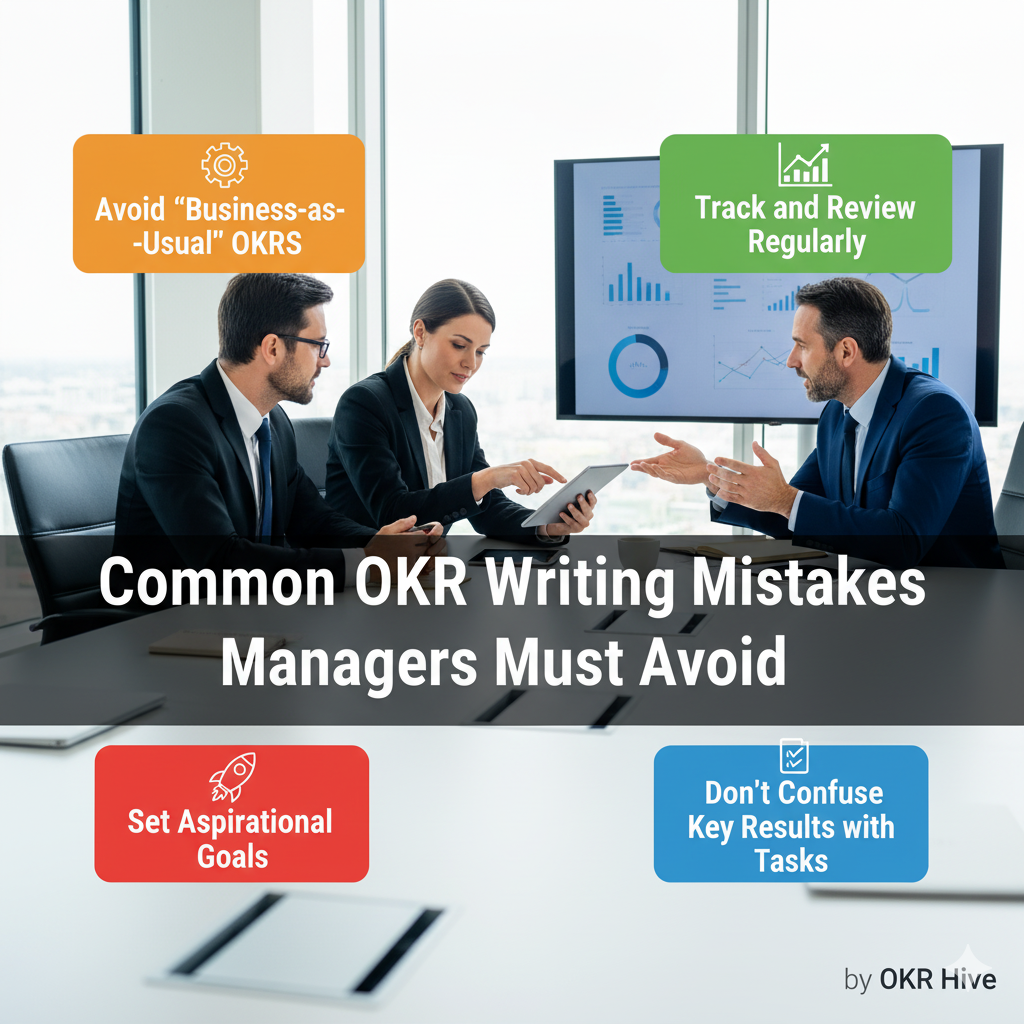
Common OKR Writing Mistakes Managers Must Avoid
Let's solidify your learning by highlighting the pitfalls. Avoiding these will put you in the top tier of leaders who know how to write OKRs.
Mistake: Setting "Business as Usual" OKRs. Your OKRs should represent meaningful change, not just your team's daily tasks. If a Key Result is something you'd hit by simply showing up, it's not a good OKR.
Mistake: Confusing Key Results with Tasks. "Launch the new marketing campaign" is a task. "Generate 500 qualified leads from the new marketing campaign" is a Key Result. Always ask, "Does this measure an outcome or just an activity?"
Mistake: Sandbagging. Setting goals you know you can easily achieve. OKRs should be aspirational. A 70% achievement on a stretch goal is often more valuable than 100% on a safe goal.
Mistake: "Set and Forget." OKRs require regular check-ins. Without OKR tracking for teams, they lose all power and become another forgotten document.
How to Track and Review OKRs for Managerial Success
Writing OKRs is only 20% of the work. The other 80% is the follow-through. A weekly or bi-weekly check-in is non-negotiable for successful OKR implementation.
A Simple OKR Check-in Agenda:
Progress Update: Briefly review each Key Result. What is the current score? (e.g., "We've moved CSAT from 85% to 88%").
Confidence Score: Have each owner rate their confidence (on a scale of 1-10) in achieving the Key Result. This is an early warning system.
Discuss Initiatives: What progress have we made on our action plans? What's blocked?
Course Correct: Based on the data, what do we need to change? Do we need to pivot our initiatives?
This rhythm of OKR tracking for teams creates a culture of accountability and continuous learning. It turns the static document you created when you learned how to write OKRs into a dynamic management system that drives real performance.
Real-World Manager OKR Examples
Let's look at two detailed examples across different functions.
Example 1: Marketing Manager
Objective: Establish Our Brand as the Thought Leader in the SaaS Security Space.
Key Result 1: Grow our target audience newsletter subscribers from 10k to 25k.
Key Result 2: Generate 5,000 downloads of our new flagship industry report.
Key Result 3: Secure 10 speaking slots at major industry conferences.
Example 2: Software Engineering Manager
Objective: Ship a Market-Leading User Onboarding Experience.
Key Result 1: Reduce the average time-to-first-value for new users from 10 minutes to 3 minutes.
Key Result 2: Increase Day-7 user retention from 40% to 65%.
Key Result 3: Achieve a user rating of 4.5/5 stars for the new onboarding flow in the app store.
Example 3: Sales Manager
Objective: Build a Predictable and Scalable Sales Engine for the New Fiscal Year.
Key Result 1: Increase average deal size from $25k to $35k by upselling the new enterprise package.
Key Result 2: Improve sales win rate from 22% to 30% across the team.
Key Result 3: Generate $1.5M in qualified pipeline from the new inbound lead process.
Example 4: Product Manager
Objective: Create the Most Intuitive and Powerful Project Management Experience on the Market.
Key Result 1: Increase the weekly adoption of the new "Automations" feature from 5% to 25% of active users.
Key Result 2: Reduce user-reported task completion time by 15% (measured via user testing surveys).
Key Result 3: Decrease the number of support tickets related to UI confusion by 40%.
This OKR framework focuses on user experience and adoption, which are leading indicators of long-term product success. Mastering how to write OKRs for a product means focusing on user behavior and value realization, not just feature releases.
Final Takeaways: Writing OKRs That Drive Impact
Mastering how to write OKRs is a superpower for any manager. It replaces ambiguity with clarity and activity with impact. Remember, the goal is not perfection on the first try. The goal is to create a living, breathing system that focuses your team's talent and energy on what matters most.
Start small. Take one team goal for the next quarter and apply this OKR framework. Use the step-by-step guide. Involve your team in the process. Embrace the regular check-in rhythm. You will be amazed at the shift in focus, morale, and results.
Now that you know how to write OKRs, what will you achieve?
Frequently Asked Questions (FAQs)
1. How many OKRs should a team have?
We recommend 3-5 Objectives per team per quarter, with 2-5 Key Results each. Having too many OKRs dilutes focus and defeats the purpose of the framework. Less is more.
2. What's the difference between a Key Result and a Project?
A Key Result is a measurable outcome. A project (or initiative) is the action you take to influence that outcome. You achieve Key Results by successfully completing projects. This distinction is a critical part of learning how to write OKRs effectively. For example, "Launch a new website" is a project. "Increase organic website traffic by 30%" is a Key Result.
3. What if my team doesn't hit its OKRs?
This is a critical mindset shift. OKRs are meant to be ambitious. Scoring 60-70% on a stretch goal is often a great success. The focus should be on learning. In your review, ask: "Why didn't we hit 100%? What did we learn? How will that inform our next cycle?"
4. How do I score my OKRs at the end of the quarter?
The most common method is simple percentage-based scoring. If a Key Result was to "Grow revenue from $100k to $150k," and you achieved $140k, your score is 80% (($140k - $100k) / ($150k - $100k)). The Objective's score is typically the average of its Key Result scores.
5. We're a new manager. Should we write the OKRs ourselves or let the team draft them?
For your first cycle, we recommend a hybrid approach. You should come to the team with a well-researched draft. This shows you've done your strategic homework and understand the company's priorities. Then, facilitate a session where the team critiques and improves them. This balances leadership direction with team collaboration, creating a powerful learning experience for everyone in how to write OKRs effectively.


