Implementing OKRs: How One University Achieved Its Goals?
Implementing OKRs

67% of University Initiatives Fail. Is Your Strategic Plan Next?
A recent study reveals that over two-thirds of university initiatives never achieve their intended outcomes. That beautifully crafted strategic plan often becomes a ceremonial artifact rather than an operational roadmap.
While faculty advance research and staff maintain operations, institutional goals get lost between departments.
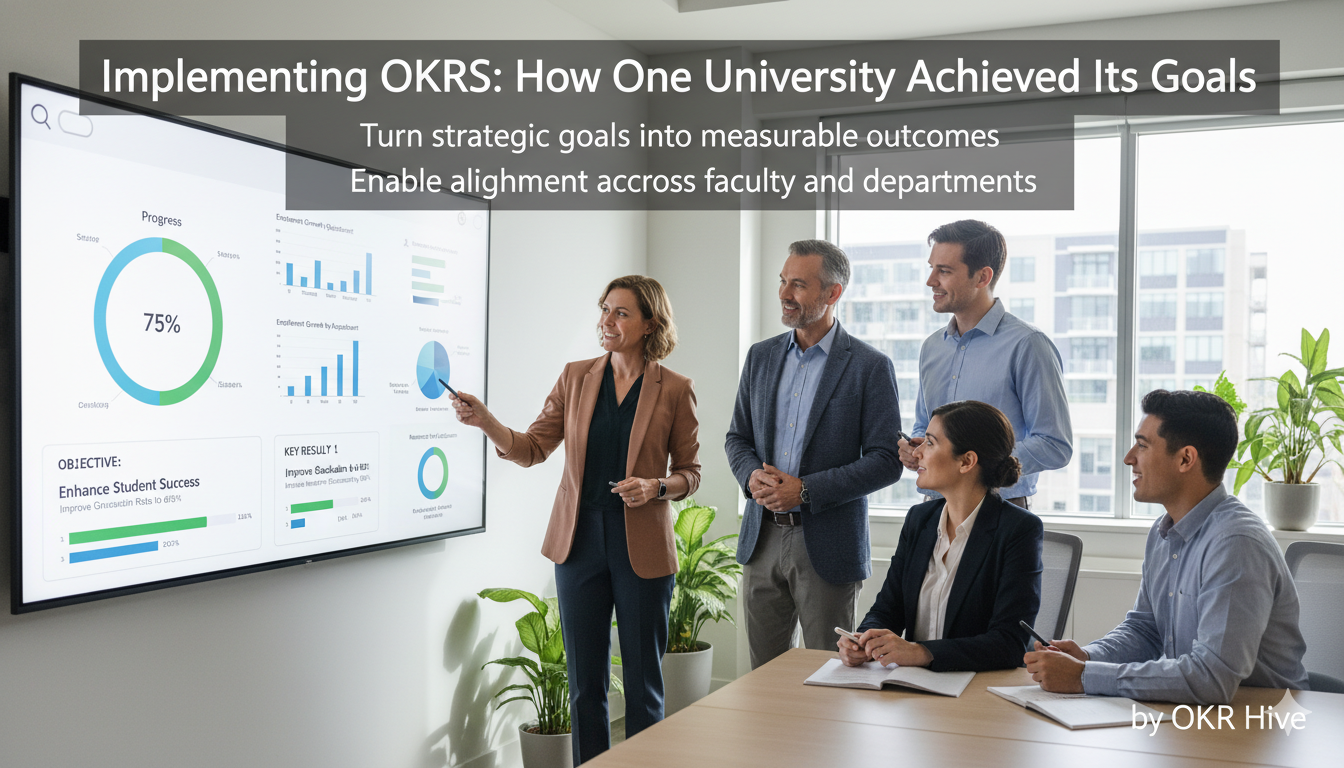
Implementing OKRs: How One University Achieved Its Goals?
Implementing OKRs bridges this gap between ambition and measurable action. This framework provides the clarity needed to transform your institution from planning to actually achieving results.
Our strategic playbook for implementing OKRs in universities successfully moves beyond theory into practical steps designed for higher education's unique environment, offering a proven solution to the execution crisis facing modern universities.
Why Standard Strategic Plans Fail in Academia (And Why OKRs Succeed)
The traditional university structure is a collection of silos. The biology department, the registrar's office, the student affairs team—all have different priorities. A top-down strategic plan often fails to connect with these individual units. It lacks the flexibility to adapt and rarely defines success in measurable terms.
The OKR methodology fixes this by being both aspirational and brutally practical.
An Objective is the ambitious, qualitative goal—the "what." It should be inspirational and meaningful.
Key Results are the measurable, quantitative outcomes—the "how." They define what success looks like with clear metrics.
For example, a vague strategic goal like "Improve Student Success" becomes a powerful OKR:
Objective: Create an unparalleled first-year student experience that fosters belonging and academic confidence.
Key Result 1: Increase first-to-second-year retention rate from 80% to 85%.
Key Result 2: Achieve a 90% satisfaction score on the First-Year Experience survey.
Key Result 3: Ensure 95% of first-year students have a completed academic success plan by the end of their first semester.
This shift from vague to specific is transformative. It creates a shared language of achievement for everyone, from deans to department assistants.
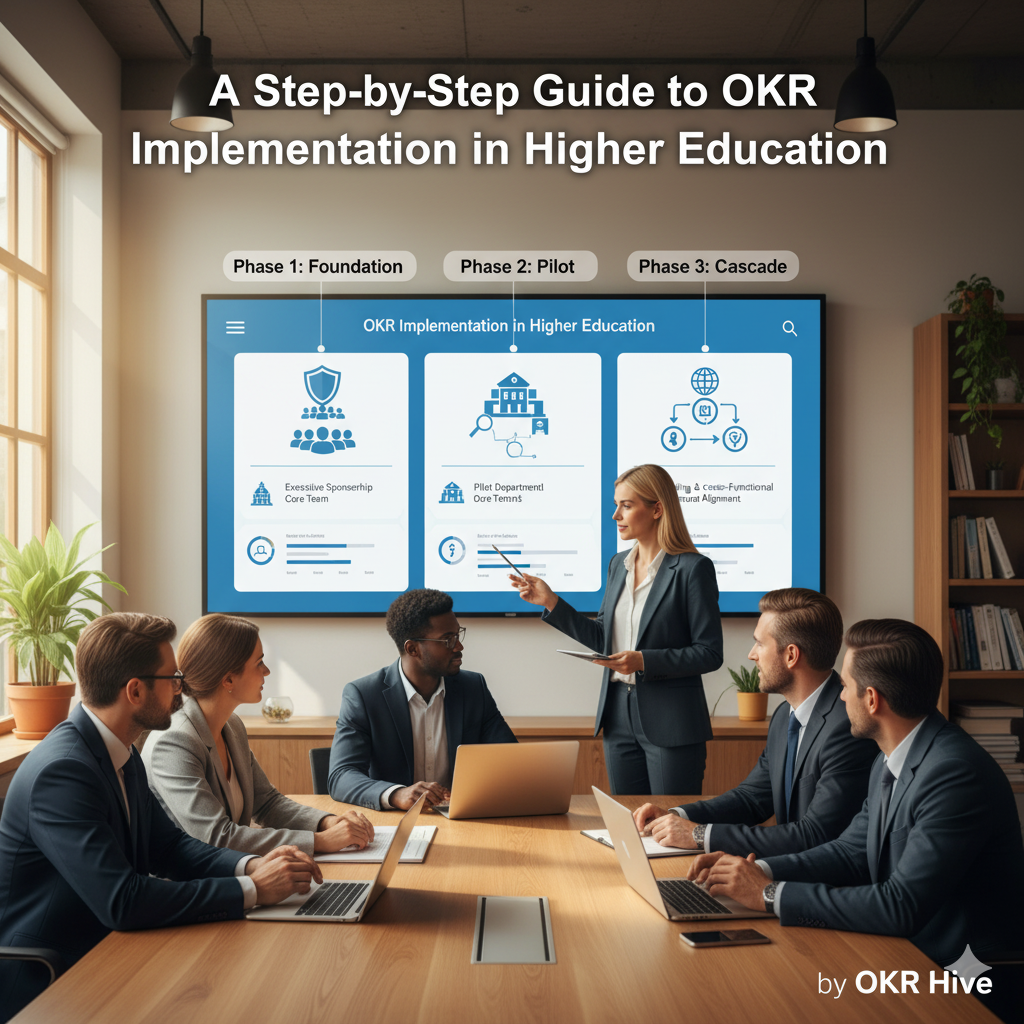
A Step-by-Step Guide to OKR Implementation in Higher Education
Rushing an OKR rollout is the most common mistake. A successful launch requires careful planning and widespread buy-in. Follow this phased approach.
A Step-by-Step Guide to OKR Implementation in Higher Education
Phase 1: The Foundation (Laying the Groundwork)
This pre-launch phase is about strategy and coalition-building.
Secure Executive Sponsorship: The OKR implementation must be championed by the President, Provost, or a senior VP. They must communicate why this is critical for the university's future.
Form an OKR Core Team: Assemble a small, cross-functional team. Include representatives from academic affairs, administration, finance, and IT. This team will shepherd the process.
Define Your University-Level OKRs: Before anyone else can set goals, leadership must. What are the 3-5 most important institutional priorities for the coming year? This top-level OKR setup provides the "North Star" for the entire organization.
Invest in Training: Do not assume people know what OKRs are. Host workshops that explain the "why" and the "how." Use university OKR examples relevant to different roles.
Phase 2: The Pilot (Proving the Concept)
Do not roll out OKRs to the entire university at once. Start with a pilot group.
Choose 2-3 willing departments or schools—one academic (e.g., College of Engineering) and one administrative (e.g., Admissions Office).
This pilot allows you to iron out kinks in the process, gather feedback, and create internal success stories.
These pilot teams will become your champions and provide real-world case studies on implementing OKRs in a university for the broader rollout.
Phase 3: The Cascade (Scaling with Purpose)
After a successful pilot (typically one or two cycles), you can scale.
Communicate the "Why": Re-emphasize the university-level OKRs and how each unit's goals contribute to the bigger picture.
Facilitate Team-Level OKR Creation: Department heads and deans work with their teams to create their own OKRs that directly support the institutional goals. This is the heart of team alignment with OKRs.
Encourage Cross-Functional OKRs: Identify goals that require collaboration. For example, an OKR about improving graduation rates for STEM majors might involve the College of Arts & Sciences, the Tutoring Center, and Career Services.
Aligning Academic and Administrative Goals with OKRs: A Practical View
The magic of implementing OKRs is its power to connect seemingly disparate functions. Let's look at examples of implementing OKRs in higher education institutions that show this alignment in action.
University-Level Objective: Enhance our national reputation for undergraduate teaching and research.
Academic OKRs (History Department) | Administrative OKRs (IT Department) |
Objective: Become a recognized leader in innovative undergraduate history education. | Objective: Provide a world-class digital infrastructure that empowers teaching and learning. |
KR1: Increase student rating of "teaching innovation" on course evaluations from 3.5 to 4.2. | KR1: Achieve 99.9% uptime for the Learning Management System during peak academic hours. |
KR2: Launch 2 new digital history project-based courses. | KR2: Roll out new classroom collaboration software to 100% of teaching spaces. |
KR3: 75% of senior capstone projects will incorporate public-facing digital components. | KR3: Reduce faculty-reported tech ticket resolution time by 25%. |
Notice how both sets of academic and administrative OKRs serve the same top-level objective? The History Department is innovating in pedagogy, while the IT Department is ensuring the technology foundation is robust and supportive. They are no longer working in isolation.
Tracking, Scoring, and Learning: The Cycle of Improvement
A goal without tracking is just a wish. OKR tracking in education must be simple and transparent.
Make OKRs Visible: Use a shared platform or internal website where anyone can view the university's and each department's OKRs. Transparency builds accountability and connection.
Establish Regular Check-Ins: Teams should have brief (20-30 minute) weekly or bi-weekly meetings to discuss progress on their Key Results. What's working? What's blocked?
Score at the End of the Cycle: At the end of the quarter or semester, score each Key Result from 0.0 to 1.0. A score of 0.7 to 1.0 (green) indicates great success. A score of 0.4 to 0.6 (yellow) shows good progress, and 0.0 to 0.3 (red) signals a goal was missed.
Scoring is not for performance evaluation. It is a tool for learning. Why did we only score a 0.5? Was the goal too ambitious? Did we encounter an unforeseen challenge? This reflective practice is how you measure the success of OKR implementation in educational institutions—not just by goals hit, but by the quality of learning and adaptation it creates.
Real-World Case Study: Implementing OKRs at a Public University
Consider a mid-sized public university struggling with student retention, particularly in STEM fields. Their strategic plan listed "improve graduation rates" as a priority for years with little movement.
They began implementing OKRs with a focused, cross-functional approach.
University Objective: Dramatically improve persistence and graduation for students in foundational STEM courses.
A "STEM Persistence Taskforce" was formed with faculty from Biology, Chemistry, and Math, plus staff from the Tutoring Center, Academic Advising, and Institutional Research.
Their OKR was:
Key Result 1: Reduce the DFW (Drop, Fail, Withdraw) rate in 5 key gateway STEM courses from 30% to 22%.
Key Result 2: Increase utilization of peer tutoring for these courses by 50%.
Key Result 3: Ensure 100% of students who score below a C- on the first midterm receive outreach from an advisor.
By making the goal specific and collaborative, they moved from vague concern to coordinated action. The OKR rollout forced conversations that had never happened before. The result? After two semesters, they surpassed their DFW rate target, hitting 20%, and saw a corresponding 3% bump in sophomore retention for STEM majors. This is the power of a focused OKR framework for universities.
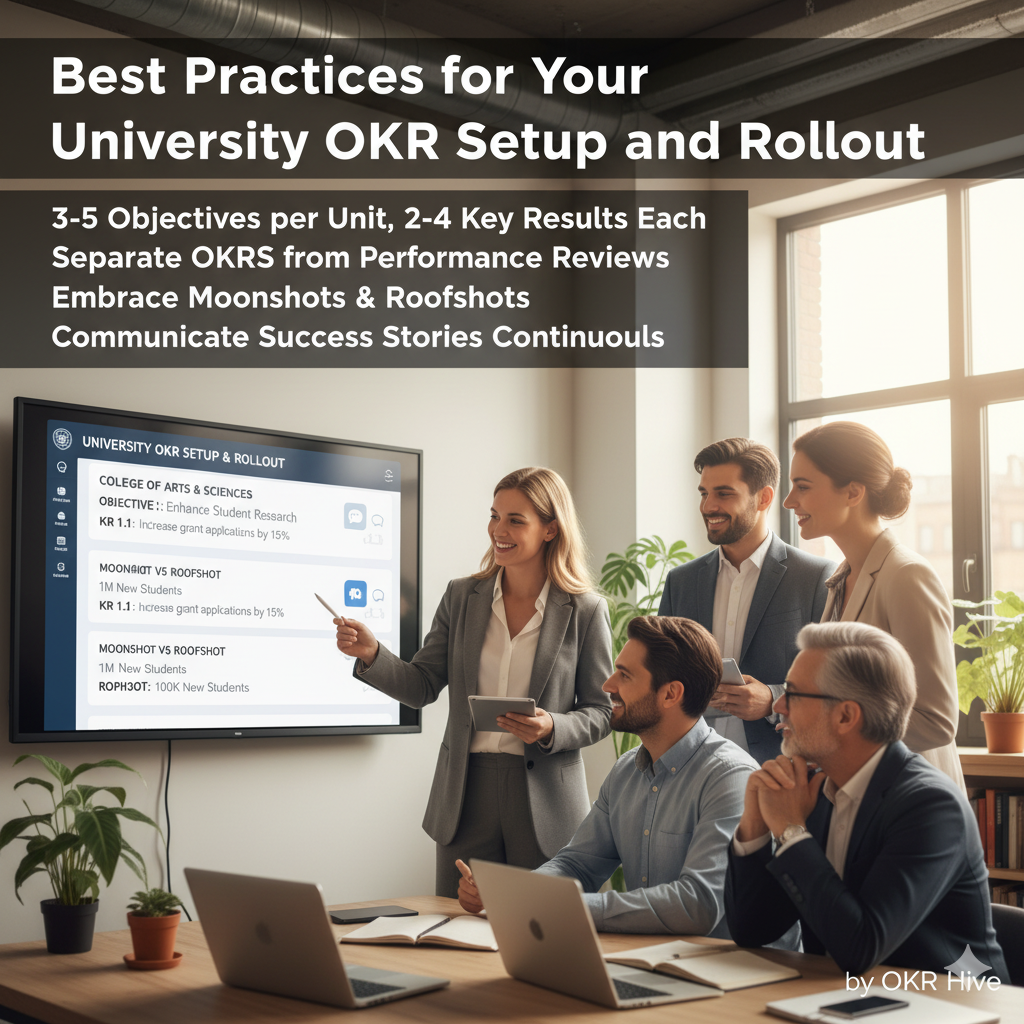
Best Practices for Your University OKR Setup and Rollout
Best Practices for Your University OKR Setup and Rollout
Less is More: 3-5 Objectives per unit, with 2-4 Key Results each. Too many goals lead to a lack of focus.
Separate OKRs from Performance Reviews: This is the most critical rule. If OKRs are tied to salary, people will set easy, safe goals. The purpose is to inspire stretch goals and honest reflection.
Embrace "Moonshots" and "Roofshots": A "Moonshot" OKR is a stretch goal where success at 70% is excellent. A "Roofshot" is a more achievable, essential goal where you expect to hit 100%. Have a mix of both.
Communicate: Continuously share success stories and learnings from across the university. This builds momentum and a culture of goal-setting.
Conclusion: From Planning to Performance
Implementing OKRs is not about adding another administrative task. It is about creating a culture of clarity, alignment, and execution. It replaces the annual dust-gathering strategic plan with a dynamic, living process that truly connects the work of every faculty and staff member to the institution's highest aspirations.
The journey requires commitment, but the payoff is a more agile, focused, and successful university. It’s time to stop planning and start doing.
Frequently Asked Questions (FAQs)
How does this approach differ from our strategic plan?
Your strategic plan sets the destination. The OKR methodology provides the specific, measurable roadmap to get there, translating vision into actionable quarterly priorities for teams and individuals.
Won't this create more work for our already busy faculty and staff?
Initially, there is a learning curve. However, OKRs are designed to reduce wasted effort by creating extreme clarity on priorities. In the long run, they save time by eliminating confusion and misaligned projects, allowing people to focus on what truly matters.
Is a 0.6 score on an ambitious goal a failure?
Not at all! For ambitious "moonshot" goals, scoring 0.6-0.7 represents major progress. The focus is on learning and achievement beyond what safe goals would deliver.
Can this framework work for research goals?
*Absolutely. A research lab might set an Objective to "Publish groundbreaking findings," with Key Results like "Submit 3 papers to top-tier journals" and "Secure $500k in new grants."*
What is the biggest pitfall to avoid when implementing OKRs for the first time?
The two most common pitfalls are
1) Setting too many OKRs, which dilutes focus
2) Tying OKR scores directly to performance reviews and bonuses.
This second point kills innovation and encourages sandbagging. Ensure leadership champions the framework as a tool for growth, not for evaluation.


