Tired of OKR Challenges? Here’s How to End Them For Good
OKR Challenges

A staggering 80% of C-suite leaders report their strategic priorities are not aligned with the day-to-day work of their teams.
This isn't a small communication gap; it's a chasm. Companies invest immense energy in crafting a brilliant strategy, only to watch it disintegrate as it trickles down through the organization.
If your team's ambitious OKRs are fading into the background, becoming just another item on a long to-do list, you are experiencing this exact silent crisis.
Tired of OKR Challenges? Here’s How to End Them For Good
You’re facing the very real and common OKR challenges that derail most implementations.
These hurdles are why many organizations experience OKR failure. But it doesn't have to be this way. The problem is rarely the OKR framework itself. It's how we implement and track it.
This post goes beyond the basic advice. We will diagnose the real-world OKR challenges teams struggle with. More importantly, we will show you how to fix OKR failure using modern tools and strategies.
Let's transform your goal-setting from a chore into your biggest competitive advantage.
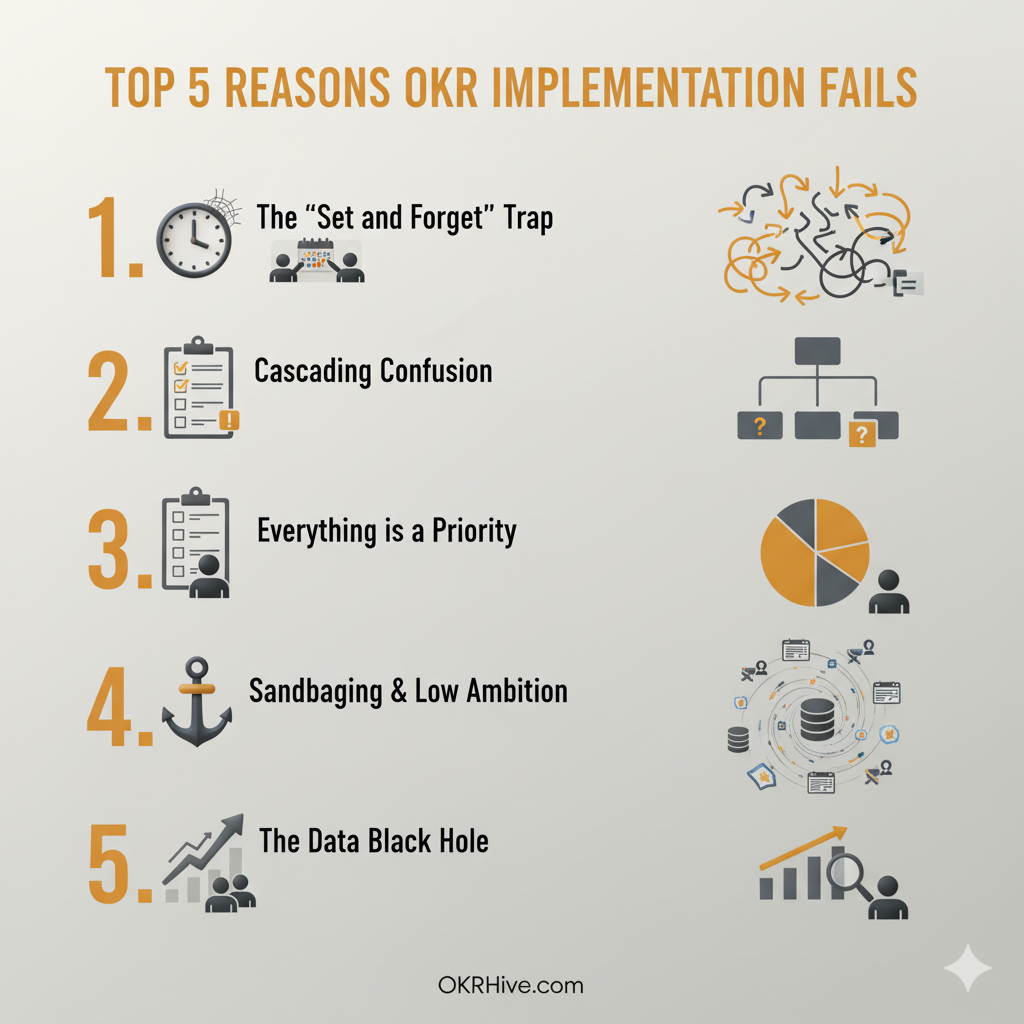
Diagnosis - The 5 Most Common OKR Failure Examples
Why do OKRs stumble? The answer usually lies in a few critical missteps. Recognizing these common OKR mistakes is the first step toward overcoming them.
Common OKR Failure Examples
1. The "Set and Forget" Trap
This is the most frequent killer of OKRs. A team spends a day in a workshop, sets their Objectives and Key Results, and then... goes back to business as usual.
The Failure: OKRs are posted on a static slide or document. They are never reviewed, updated, or discussed. They become irrelevant by the second week.
How it Feels: Your team feels like the OKR process is just corporate theater. It doesn't impact their daily work.
2. Cascading Confusion: No Team Alignment
Leadership sets high-level OKRs. Then, they simply "copy and paste" these goals down to every department.
The Failure: The marketing team gets an Objective about "winning in North America," but their work is global. The engineering team inherits a revenue target they can't directly influence. This lack of true OKR implementation creates frustration.
How it Feels: Teams are working on goals that don't fit their function. They feel disconnected from the company's mission.
3. The "Everything is a Priority" Problem
Ambition is good. But listing 10 Objectives for a single team is a recipe for disaster. It creates a massive checklist, not a focused strategy.
The Failure: With too many OKRs, nothing is truly important. Teams scatter their effort and make little progress on anything. This is a classic common OKR failure example.
How it Feels: Your team is overwhelmed and burned out. They are busy, but not productive.
4. Sandbagging and Low Ambition
Teams get nervous about missing their targets. So, they set goals they know they can 100% achieve. These are tasks, not ambitious, inspirational Objectives.
The Failure: The company misses out on innovation and stretch growth. OKRs become a glorified to-do list, failing to push the organization forward.
How it Feels: Work feels routine and uninspiring. There's no excitement about achieving a goal that was easy from the start.
5. The Data Black Hole
Key Results (KRs) are meant to be measurable. But if the data lives in five different tools and takes a day to compile, no one will track it.
The Failure: Check-in meetings are spent debating data accuracy instead of discussing progress and next steps. Without a single source of truth, confidence in the entire process erodes.
How it Feels: Your team is flying blind. You don't know if you're winning or losing until the quarter is over.
The Solution - Overcoming OKR Challenges with a Modern Approach
Understanding these problems is half the battle. The other half is fixing them. Overcoming OKR challenges requires a shift in both mindset and tooling.
The Secret Weapon? Integrating technology into your OKR best practices. The right OKR software acts as a force multiplier, automating the hard parts and making success repeatable.
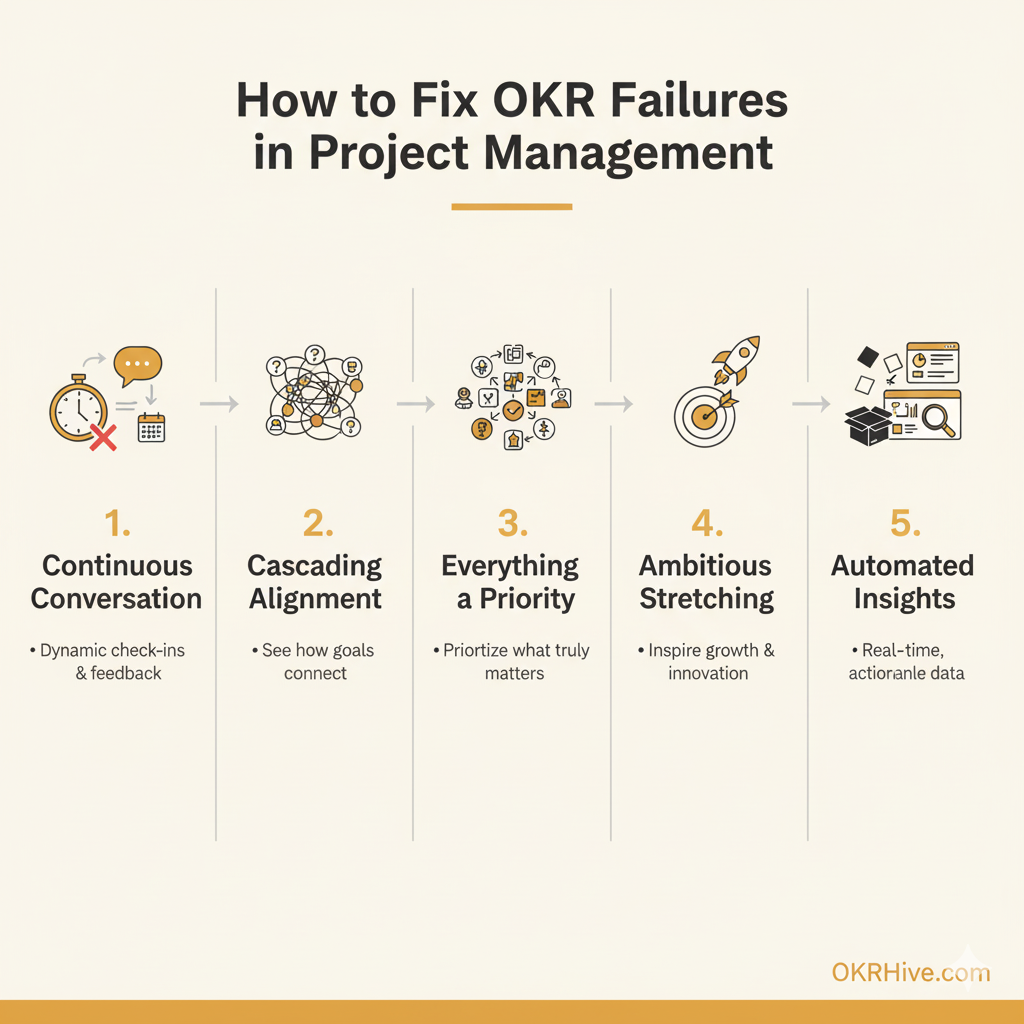
Let's revisit those five failures and see how technology provides the cure.
How To Fix OKR Five Failures
How to Fix OKR Failure #1: From "Set and Forget" to "Continuous Conversation"
Static documents kill momentum. You need a dynamic system.
The Software Solution: A dedicated OKR tracking tool makes your goals living, breathing entities. It encourages weekly check-ins where teams can update progress, confidence levels, and add comments.
The Result: Goals stay top-of-mind. Leaders can see progress at a glance. The conversation shifts from "What are your OKRs?" to "How can we help you overcome that blocker?"
This is the core of how to use technology to eliminate OKR challenges related to visibility and engagement.
How to Fix OKR Failure #2: From "Cascading Confusion" to "Visible Alignment"
When goals are siloed in departments, alignment is impossible.
The Software Solution: Modern goal management software provides a visual hierarchy. You can see how the CEO's Objective connects to the marketing team's Key Result, and how that connects to an individual's project.
The Result: Every employee understands how their work contributes to the company's mission. This is a powerful way to use OKR software for better goal alignment. It turns a top-down cascade into a connected network of purpose.
How to Fix OKR Failure #3: From "Everything is a Priority" to "Ruthless Focus"
Too many goals dilute effort. You need a system that enforces focus.
The Software Solution: Good performance management software for OKRs has built-in guardrails. It might limit the number of active OKRs per team. It visually highlights the company's top priorities for the quarter.
The Result: Leaders are forced to make strategic choices. Teams can channel their collective energy into a few, critical outcomes. This clarity is a primary benefit of using OKR tracking software for performance management.
How to Fix OKR Failure #4: From "Sandbagging" to "Ambitious Stretching"
Culture drives ambition, but tools can reinforce it.
The Software Solution: The best OKR software allows teams to set a "stretch" goal and track confidence levels separately from completion. It celebrates learning from a "70% achieved" stretch goal more than a "100% achieved" easy goal.
The Result: The platform itself reinforces the mindset that OKRs are for learning and reaching, not just for performance reviews. It creates a safer environment for ambition.
How to Fix OKR Failure #5: From "Data Black Hole" to "Automated Insights"
Manual data entry is a time-sink and an error-magnet.
The Software Solution: This is where OKR software becomes a game-changer. The best tools offer integrations that automatically pull data from your analytics platforms, CRM, and project management tools.
The Result: Your Key Results update in real-time. Check-in meetings start with an accurate, shared view of the data. This enables solving OKR challenges with data-driven tools, allowing the team to focus on strategy, not spreadsheets.
Your Action Plan - Choosing the Right Tool
Now that you see the power of technology, how do you choose? The market is full of OKR tracking tools and performance management software. Your choice will define your success.
Choosing the Right Tool
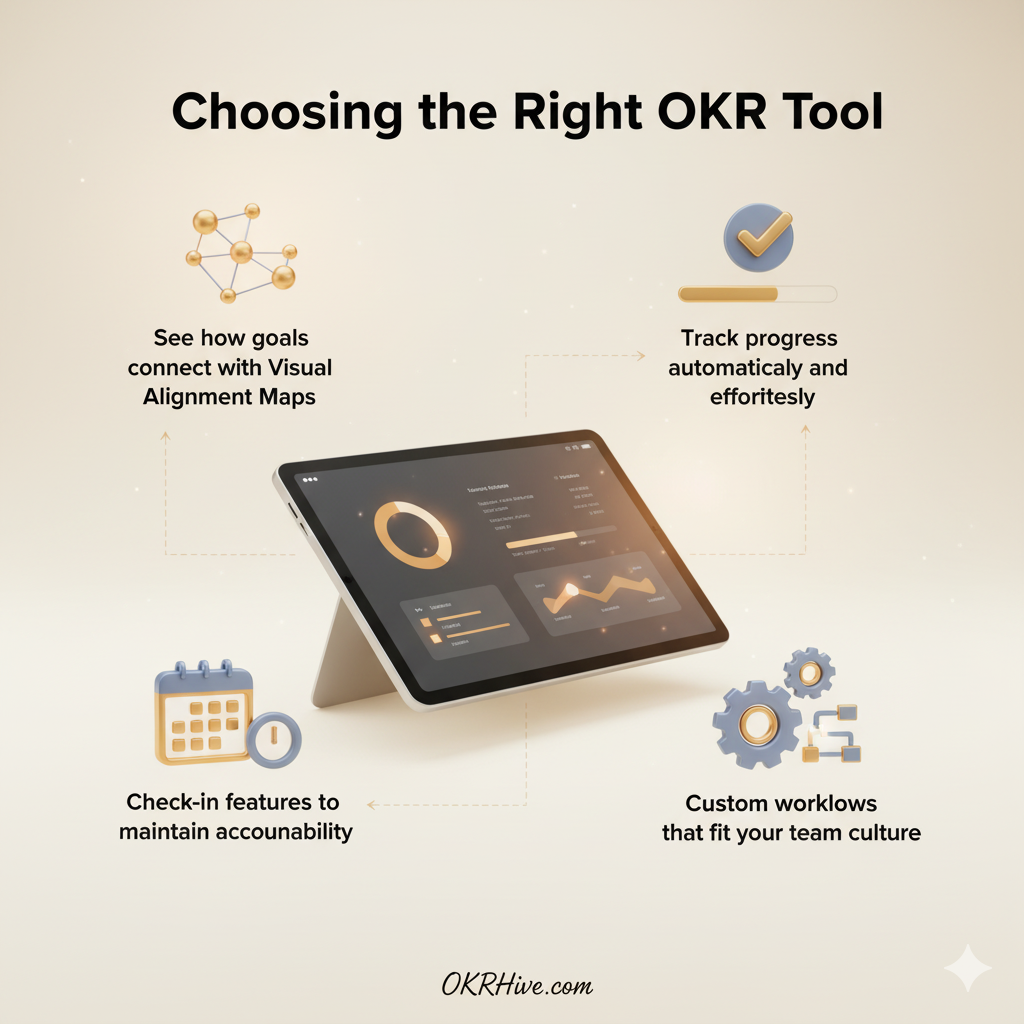
Look for a platform that offers:
Visual Alignment Maps: To see how goals connect.
Automated Progress Tracking: With integrations to your key data sources.
Easy Check-in Features: To build a rhythm of accountability.
Customizable Workflows: That fit your company's culture.
Investing in the right system is the ultimate strategy for overcoming OKR implementation challenges. It’s not just another piece of software; it’s the operating system for your company’s strategy.
Conclusion: Turn Your OKR Challenges into Your Greatest Strength
The OKR challenges you face are real. But they are not insurmountable. They are simply signs that your process needs reinforcement.
By moving away from static slides and disconnected spreadsheets, you can build a culture of focused execution. The right goal management software provides the structure, visibility, and automation needed to make OKRs a transformative habit.
Stop letting common OKR mistakes derail your progress. Embrace a modern approach that turns goal-setting from a source of frustration into your engine for growth.
Ready to Solve Your OKR Challenges?
You don't have to figure this out alone. See how a modern OKR software platform can transform your goal-setting process.
Discover firsthand how performance management tools improve OKR success, automate tracking, and get your entire team aligned and motivated.
Frequently Asked Questions (FAQs)
What is the #1 reason OKRs fail?
The number one reason is the "set and forget" mentality. OKRs require regular check-ins and active management. When treated as a quarterly event instead of an ongoing practice, they lose all relevance and power.
Can OKR software really fix our implementation problems?
Yes, absolutely. While it can't fix a poor culture alone, the right OKR software provides the structure and automation that makes good OKR best practices easy to follow. It solves core issues like lack of visibility, misalignment, and manual tracking.
What are some common OKR failure examples related to Key Results?
The most common examples are Key Results that are not measurable (e.g., "make the website better"), are output-based instead of outcome-based (e.g., "ship 5 new features"), or are not ambitious enough to inspire the team.
How does OKR software help with goal alignment?
Goal management software creates a visual "nesting" structure. You can literally see how the IT department's Objective ladders up to the company's top goal. This transparency ensures everyone is pulling in the same direction, eliminating siloed work.
We're a small team. Do we need dedicated OKR tracking tools?
Even for small teams, using a dedicated tool from the start is a smart investment. It builds strong habits early, prevents the chaos of using disconnected spreadsheets as you grow, and ensures that your goal-setting process scales with your company.


