How Proper OKR Implementation 3x Marketing Productivity

OKR Implementation
What if everything you know about setting marketing goals is actively sabotaging your results?
The brutal truth is that 83% of your team's collective effort is currently being wasted—not on laziness, but on activity that lacks a unified direction. This is the staggering cost of a broken OKR implementation.

How Proper OKR Implementation 3x Marketing Productivity
That initial launch energy inevitably crashes into the reality of a poorly executed OKR rollout plan, leaving your team viewing objectives as a tedious reporting exercise.
This guide cuts through the generic advice. We expose why standard goal-setting fails and deliver the candid, battle-tested strategy for successfully implementing OKRs that finally bridges the gap between ambitious plans and tangible, game-changing results.
The Silent OKR Killers: What No One Tells You About Implementing OKRs
The failure of an OKR rollout plan rarely starts with the framework. It starts in the shadows of your existing culture.
Killer #1: The "Set and Forget" Fallacy
Many leaders treat OKRs like a quarterly event. They are announced, then filed away. Without constant conversation, they become irrelevant. Your team's priorities shift daily. If OKRs don't help them navigate those shifts, they will be abandoned.
Killer #2: The Illusion of Buy-In
You presented. People nodded. You mistook silence for agreement. True team OKR buy-in is not given in a meeting. It is earned through involvement, trust, and seeing real impact. Without a deliberate strategy for how to engage marketing teams during OKR implementation, you only have compliance, not commitment.
Killer #3: The KPI Masquerade
This is the most common error. Teams list their regular KPIs and call them Key Results. "Increase website traffic by 10%" is a KPI. "Launch a new pillar content strategy to become the #1 ranked source for [topic] and drive 10,000 targeted visitors" points to an outcome. This distinction is the heart of successful OKR implementation.
The Anatomy of a Resilient OKR Framework
A resilient OKR system isn't just written. It's built. It has layers that most companies ignore.
Think of it like this:
The Foundation: Culture & Belief. Does your team believe ambitious goals are safe? Do they trust that a 70% score on a stretch goal is a win?
The Structure: Rhythm & Rituals. How often do you talk about OKRs? Is it a weekly heartbeat or a quarterly autopsy?
The Finish: Visibility & Storytelling. Are OKRs hidden in a spreadsheet? Or are they a living story of your team's ambition and progress?
Most OKR implementation efforts only focus on the structure. They miss the foundation and the finish. That’s why they crumble.
The Manager's Playbook: A 5-Phase OKR Implementation Process for True Adoption
This is not a linear checklist. It's a cyclical process that builds momentum through continuous reinforcement. Think of it as your definitive guide to achieving deep OKR adoption across your organization.
Phase 1: The Pre-Mortem (Before You Write a Word)
Instead of jumping in, start by imagining failure. Gather your team and ask: "It's three months from now. Our process for implementing OKRs has completely failed. What happened?"
You will hear powerful answers:
"We were too busy with client work."
"The goals were handed down from leadership."
"We didn't have the tools or budget."
This pre-mortem does two things. It exposes risks early. And it proves you value your team's input, which is the first step to how to get marketing team buy-in for OKRs.
Phase 2: The Co-Creation Sprint
Do not write the OKRs for your team. Act as a facilitator.
How to engage marketing teams during OKR adoption from the start:
Problem-First, Not Solution-First: Don't start with "Our objective is..." Start with "What is the biggest problem our marketing needs to solve this quarter?" or "What would represent a massive leap forward?"
Use the "We Will..." Format: Frame Objectives as bold declarations. Instead of "Improve Brand Awareness," try "We will become the most trusted voice in the sustainable beauty space." This language is more powerful and inspiring.
Pressure-Test Key Results: For each draft Objective, ask the team: "If we achieve all these Key Results, will we have truly met the Objective?" If the answer is no, you have a gap.
This collaborative implementing OKRs process transforms the goals from "yours" to "ours."
Phase 3: The Activation Campaign
Your OKRs are set. Now, launch them like a marketing campaign.
How to communicate OKRs effectively to marketing teams:
Create a "Launch Asset": Don't just email a list. Create a simple, visually appealing one-pager or a short video explaining the why behind each OKR.
Host a "Q1 Kick-Off": Make it an event. Celebrate the start of a new journey. Have team leads present the OKRs they helped create.
Define "What Does This Mean For Me?": This is the most critical step. For each sub-team (content, social, PR), explicitly connect their weekly tasks to the larger Key Results. This is the essence of marketing team alignment.
This phase turns your OKR rollout plan from an announcement into an invitation.
Phase 4: The Rhythm of Review
This is where most OKR implementation efforts die. You must create a consistent heartbeat for your goals.
Effective OKR tracking for teams isn't about reporting. It's about problem-solving.
Weekly Check-Ins: Dedicate 15 minutes in your team meeting. Don't just read numbers. Ask:
"On a scale of 1-10, what's our confidence score for each KR?"
"What did we learn last week that affects our confidence?"
"What one thing can we do this week to increase that score?"
The "Blockers" Board: Visibly track what is stopping progress. Is it a budget approval? A technical delay? Making impediments public is key to ensuring accountability in marketing team OKR adoption.
This rhythm keeps OKRs alive, relevant, and connected to the daily grind.
Phase 5: The Reflective Close
At the quarter's end, you must close the loop. This meeting is not a performance review. It is a learning lab.
Celebrate Learning, Not Just Winning: What did we discover about our market, our channels, or ourselves?
Score with Honesty: Grade your final achievement (0.0 - 1.0). A 0.7 is a great score for a stretch goal. A 1.0 might mean the goal was too easy.
Decide: Re-up, Adapt, or Retire? Should this OKR continue into the next quarter? Does it need to change? Or is it done?
This reflective practice solidifies a culture of growth and is a core OKR best practice.
Connecting the Dots: A Practical Marketing OKR Example
Let's move from theory to practice. Here’s how a typical goal evolves into a powerful OKR.
The Basic Goal: "We need more leads from our content."
The Flawed OKR:
Objective: Improve Content Marketing
Key Result 1: Publish 20 blog posts.
Key Result 2: Increase lead count by 15%.
This is weak. The Objective is bland. The Key Results are a mix of activity (publishing) and a vague outcome.
The Resilient OKR:
Objective: We will transform our blog into a primary engine for high-value lead generation.
Key Result 1: Generate 400 Marketing Qualified Leads from 5 new cornerstone content pieces.
Key Result 2: Increase the blog-to-newsletter conversion rate from 2% to 5%.
Key Result 3: Achieve a "keyword top 3" ranking for 10 high-intent commercial search terms.
See the difference? The Objective is a bold declaration. The Key Results are specific, measurable outcomes that, together, paint a clear picture of success. This is the result of a thoughtful OKR implementation.
Your Anti-Failure Checklist: Ensuring Accountability in Marketing Team OKR Adoption
Go beyond the basics. Use this advanced checklist to secure successful OKR implementation.
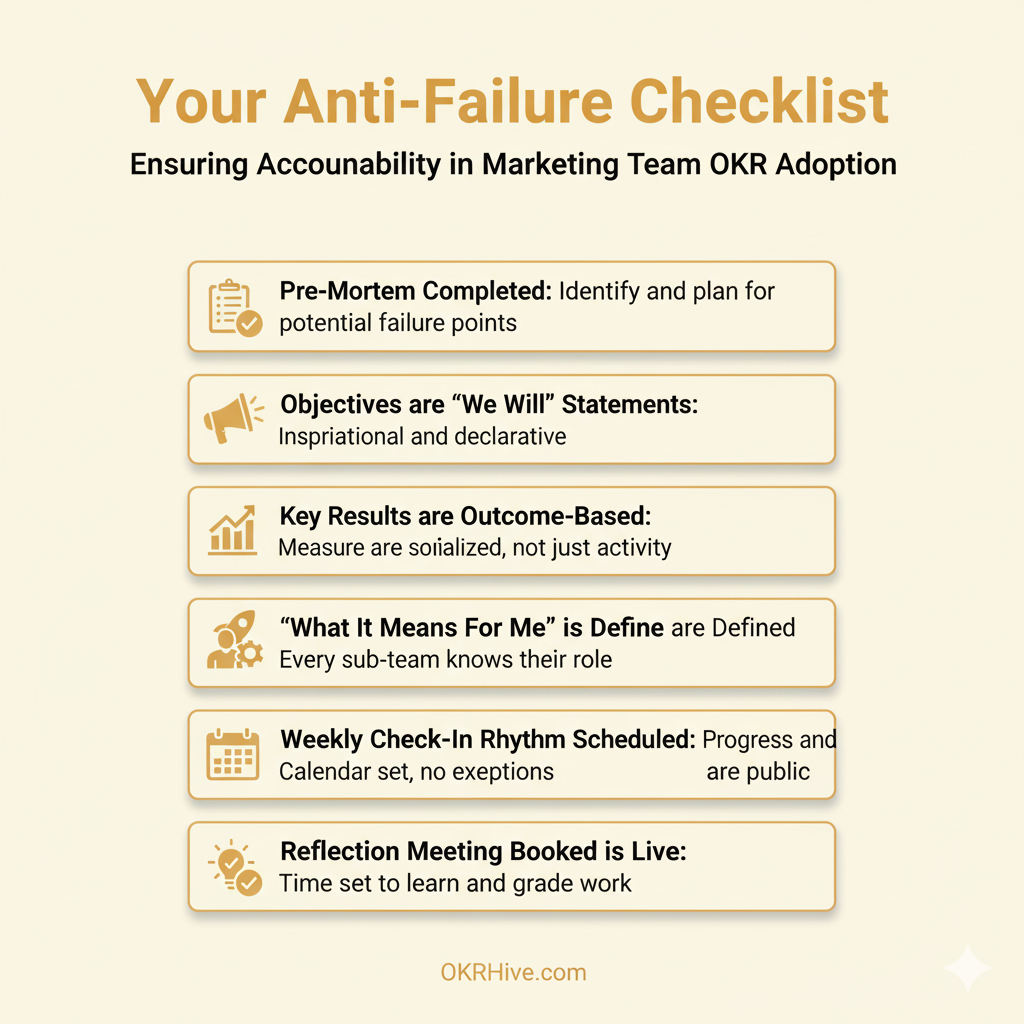
Anti-Failure Checklist in Marketing Team OKR Adoption
Pre-Mortem Completed: We've identified and planned for potential failure points.
Objectives are "We Will" Statements: They are inspirational and declarative.
Key Results are Outcome-Based: They measure impact, not activity.
A Launch Campaign is Planned: OKRs will be socialized, not just announced.
"What It Means For Me" is Defined: Every sub-team knows their role.
A Weekly Check-In Rhythm is Scheduled: It's on the calendar, no exceptions.
A Visual Progress Board is Live: Progress and blockers are public.
A Reflection Meeting is Booked: We have time set to learn and grade our work.
Conclusion: From Mandate to Movement
A truly successful OKR implementation is not about installing a new process. It's about sparking a cultural shift. It’s about moving from a top-down mandate to a grassroots movement where every team member understands how their work moves the needle.
It requires you to be a facilitator, a communicator, and a coach. It demands that you invest in the "why" and the "how," not just the "what."
The reward is a marketing team that is more aligned, more empowered, and more impactful than you thought possible. Stop implementing OKRs. Start building a goal-driven culture.
The journey begins with a single, honest conversation. Why did your last set of goals fail? And what will you do differently this time?
Frequently Asked Questions (FAQs)
We're a small marketing team. Are OKRs too heavy for us?
No, they are a perfect fit. OKRs provide clarity and focus, which are even more critical for small teams with limited resources. Start with just one or two Objectives for the entire team to keep it simple and powerful.
How do we handle OKRs when our priorities change suddenly?
OKRs are a framework, not a straitjacket. If a company's priority shifts dramatically, you should adapt your OKRs. The key is to be transparent. Hold a quick team meeting, explain the "why" behind the change, and formally update or replace the affected OKR. This maintains trust and relevance.
What's the real difference between a KPI and a Key Result?
A KPI is a health metric you monitor continuously (e.g., Website Traffic, Customer Churn Rate). A Key Result is a measurable outcome you aim to achieve within a quarter to prove you've met a strategic objective. Think of KPIs as your vital signs and Key Results as the targets for a specific fitness program you're running this quarter.
How do we prevent OKRs from feeling like a micromanagement tool?
Focus on the "What" (the outcome), not the "How" (the tasks). Trust your team to figure out the best path to achieve the Key Results. During check-ins, discuss progress and blockers, not every single task completed. This empowers creativity and ownership.
What is a good OKR score? Is 1.0 the goal?
No, a score of 1.0 (100% achievement) often suggests your goals were not ambitious enough. For stretch goals, a score of 0.7 to 0.8 is typically considered excellent. It means you pushed hard and achieved something significant, even if you fell slightly short of the moonshot. This mindset is crucial for driving innovation.


