OKR Implementation Strategies to Transform Business Performance
OKR Implementation Strategies
What if your goal-setting process is actually holding you back? Most companies treat OKRs like a corporate ritual—beautifully formatted, then completely forgotten. The data reveals a harsh reality: 70% of strategic initiatives fail during execution.
Even worse? Only 16% of employees report their company's goals are well-aligned. This alignment crisis costs businesses millions in wasted effort and missed opportunities.
But here's the hope: organizations with strong goal alignment are 2.3x more likely to outperform competitors. This is the power of precise OKR implementation strategies.
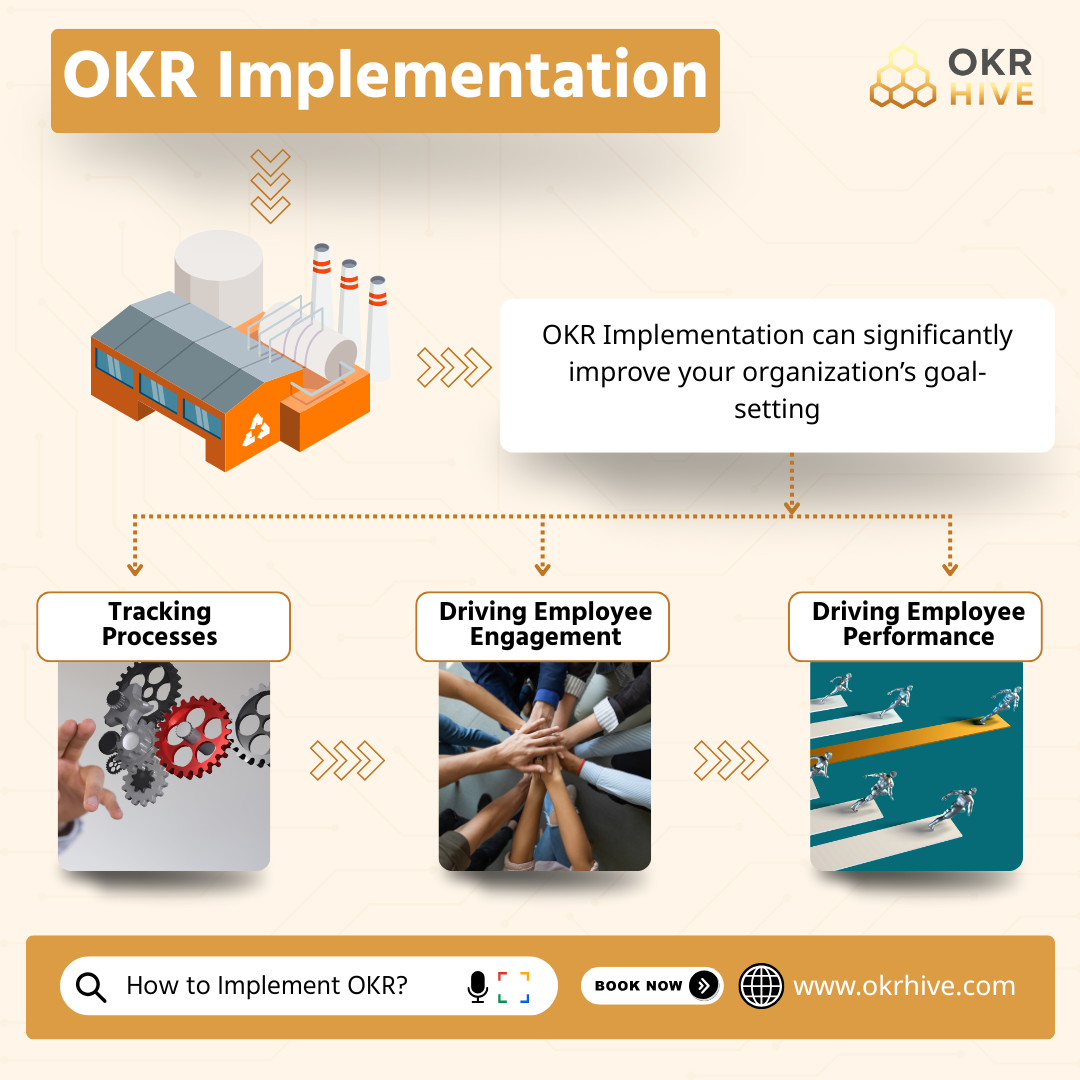
This guide reveals the execution secrets. We're sharing practical OKR implementation techniques used by successful teams who consistently beat the odds. You'll get a proven framework that transforms goals into results.
Ready to bridge the gap between planning and performance? Let's dive into the best practices for OKR implementation that deliver real impact.
Why Most OKR Implementations Fail (And How to Succeed)
Many teams treat OKRs as a yearly to-do list. They set vague goals, forget them, and then wonder why nothing changed. The most common OKR implementation challenges include lack of buy-in, poor goal quality, and no regular check-ins.
Successful OKR implementation for managers isn't about perfection. It's about creating a rhythm of focus and adaptation. The core of all effective OKR implementation strategies is to build a culture where everyone is moving in the same direction. Your approach must be simple, transparent, and engaging.
The Foundation: What Are OKRs, Really?
OKRs stand for Objectives and Key Results. It's a goal-setting framework that creates alignment and clarity.
Objective: The inspirational, qualitative goal. Where do you want to go? (Example: "Become the industry's most customer-centric brand.")
Key Results: The measurable, quantitative outcomes. How will you know you're getting there? (Example: "Increase Net Promoter Score from 30 to 50," "Reduce average customer response time to under 2 hours.")
This simple combo is powerful. But without the right OKR implementation strategies, it's just words on a page.
A Step-by-Step OKR Implementation Strategies for Business Success
Follow this phased approach to build a solid foundation. This is your playbook for how to implement OKRs effectively.
Phase 1: The Preparation Blueprint (Weeks 1-2)
Rushing this phase is a classic mistake. Proper preparation prevents poor performance.
Secure Executive Sponsorship: Leadership must champion the process. Without it, OKR adoption in teams will be weak.
Appoint an OKR Champion: This person drives the process, trains teams, and keeps everyone on track.
Communicate the 'Why': Explain why you're adopting OKRs. How will it help the company and each individual? Transparency builds trust.
Start with a Pilot Group: Don't roll out OKRs to the entire company at once. Choose one or two motivated teams to test the process. This allows you to refine your approach.
Phase 2: The Creation Sprint (Week 3)
This is where the magic starts. Use collaborative workshops to build your OKRs.
Cascading vs. Aligning: Avoid a strict top-down cascade. Instead, let company OKRs inform team OKRs. Teams should create their own OKRs that align with top-level goals, not just copy them. This fosters ownership.
Focus on Outcomes, Not Tasks: A key result should be "Launch 3 new product features" (an output). It should be "Achieve 20% user engagement with the new product module" (an outcome). This shift is critical for effective OKR strategies.
Aim for Ambition: OKRs should be stretch goals. If you consistently score 1.0 out of 1.0, your goals aren't ambitious enough. A score of 0.7 is often seen as the sweet spot.
Phase 3: The Execution Engine (Ongoing)
This is the most overlooked phase. Setting OKRs is easy. Executing them is where you win.
Make OKRs Hyper-Visible: Use a shared platform or tool. Every team member should see all companies and team OKRs. This is a core part of actionable OKR implementation strategies for aligning teams.
Implement Weekly Check-Ins: Replace long, monthly meetings with short, 15-20 minute weekly check-ins. What did you do last week to impact the OKRs? What will you do next week? Any blockers?
Track Progress Transparently: Update Key Result scores regularly. This provides a real-time pulse on your progress and keeps everyone accountable.
Phase 4: The Reflection Ritual (End of Quarter)
Learning closes the loop. Without reflection, you're just repeating cycles without improving.
Conduct a Retrospective: At the end of the quarter, hold a meeting. What worked? What didn't? What did we learn? This is how you develop proven strategies to improve OKR adoption and execution.
Score Your OKRs: Objectively score each Key Result from 0.0 to 1.0. Discuss the scores. Don't use them for performance reviews! This kills psychological safety and ambition.
Celebrate Effort and Learning: Recognize the work, even if you didn't hit the ambitious target. This reinforces the desired behavior.
Real-World OKR Implementation Examples from High-Performing Teams
Let's look at OKR implementation examples to make this concrete.
Example 1: A Customer Support Team
Objective: Transform our support from reactive to proactively helpful.
Key Result 1: Reduce incoming ticket volume by 15% by creating a new library of video tutorials.
Key Result 2: Improve Customer Satisfaction (CSAT) score from 85% to 94%.
Key Result 3: Increase the usage of our community forum by having support agents identify and post 5 top solutions weekly.
Example 2: A Software Engineering Team
Objective: Significantly improve product reliability and developer velocity.
Key Result 1: Reduce critical bug incidents reported by users by 40%.
Key Result 2: Decrease average application load time from 2.5 seconds to 1.2 seconds.
Key Result 3: Cut the time for a new developer to commit their first code change from 2 days to 4 hours.
These diverse cases provide concrete insight into effective OKR implementation strategies, showing the balance between inspiration and measurement for any department.
Tips to Overcome OKR Implementation Challenges in Teams
You will face hurdles. Here’s how to handle the most common ones.
Challenge: Setting Too Many OKRs.
- Solution: Enforce a strict limit. 3-5 Objectives with 3-5 Key Results each per team. Less is more. Focus is everything.
Challenge: "Set and Forget" Mentality.
- Solution: This is where your weekly check-ins are non-negotiable. They are the heartbeat of your OKR system and a core part of best practices for implementing OKRs in organizations.
Challenge: Lack of Employee Engagement.
- Solution: Involve team members in the creation process. When people help build the goals, they feel ownership. Show them how their work directly contributes to the company's success.
Challenge: Confusing OKRs with KPIs.
- Solution: KPIs are health metrics you maintain (e.g., website uptime). OKRs are change-oriented goals you pursue. You might have a KPI to maintain customer satisfaction, but an OKR to radically improve it.
Effective OKR Frameworks Used by High-Performing Organizations
Beyond the basics, consider these advanced effective OKR frameworks to enhance your process.
The "Superpower" Framework: Encourage individuals to set one personal "Superpower OKR" focused on their own growth. This increases personal investment and skill development.
The "Roofshot vs. Moonshot" Balance: Not every OKR needs to be a near-impossible moonshot. Have a mix of "roofshots" (ambitious but achievable goals) and "moonshots" (high-risk, high-reward goals). This maintains momentum while encouraging innovation.
Your Path Forward: From Reading to Results
Understanding OKR implementation strategies is the first step. Taking action is the next. The lessons from high-performing teams on OKR implementation are clear: start small, be consistent, and foster a culture of learning.
Don't try to be perfect in your first quarter. Your first set of OKRs will be messy, and that's okay. The goal is to start the process, learn from it, and improve each cycle. The compound effect of focused, aligned effort over time is what leads to market-leading performance.
Ready to transform your team's goal-setting?
Book a free 30-minute consultation with our experts. We'll analyze your current goals and provide a customized step-by-step OKR implementation strategy for business success. Let's build your roadmap to remarkable results together.
Frequently Asked Questions (FAQs)
1. What is the most common mistake in early OKR implementation?
The biggest error is treating OKRs as a private performance tool. True success comes from radical transparency, where every team's goals are visible to all. This fosters alignment and collective responsibility, turning individual effort into organizational momentum. Effective OKR implementation strategies are built on this foundation of openness.
2. Can we change an OKR mid-cycle?
Absolutely. If a Key Result becomes irrelevant or an Objective is no longer aligned with shifting priorities, you must adapt. The framework is designed for agility. Use your weekly check-in to propose the change, ensuring the entire team understands the rationale behind the pivot to maintain focus.
3. What's a good OKR score?
A score of 1.0 means you perfectly achieved your goal, which often suggests it wasn't ambitious enough. A score of 0.7 to 0.8 is typically considered a strong success for a stretch goal. A score of 0.3 to 0.6 shows you made good progress and learned valuable lessons. A 0.0 means you need to re-evaluate the goal or your approach.
4. What's the manager's role in the OKR process?
Managers are coaches, not dictators. Their primary role is to empower their teams by clearing blockers, providing resources, and ensuring everyone understands how their work contributes to the larger company vision. They facilitate the rhythm of the cycle but don't micromanage the "how."
5. How do we prevent OKRs from becoming just another task list?
The key is a strict focus on outcomes, not outputs. Instead of "Create a report," a Key Result should be "Reduce customer churn by 5% using insights from the new report." This shifts the team's energy from just being busy to driving meaningful impact, which is the core of successful OKR implementation strategies.


