Beyond Spreadsheets: Why Your Team Needs an OKR Platform

OKR Platform
Did you know that a staggering 67% of well-crafted strategies fail due to poor execution? This alarming statistic reveals a critical breakdown in organizational alignment.
The problem deepens when considering that 95% of employees cannot articulate their company's strategy.
This disconnect represents the silent productivity killer in modern organizations. Ambitious goals get lost in department silos. Momentum stalls as teams work at cross-purposes.
You need a system that bridges this gap between ambition and reality. You need a powerful OKR Platform.
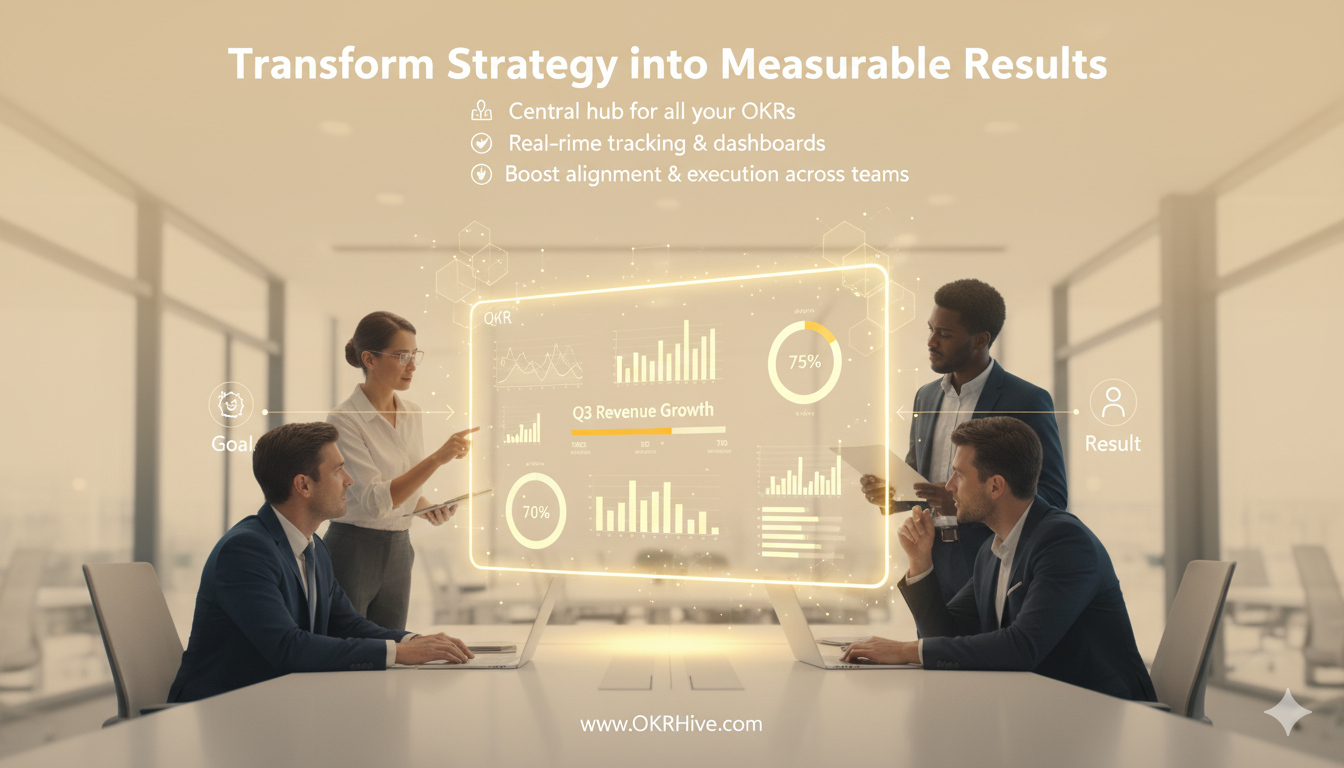
Why Your Team Needs an OKR Platform
This central hub transforms vague ideas into measurable outcomes. It creates clarity where confusion once reigned. This guide will help you select the right goal-setting system for your organization's unique needs.
Discover how the best OKR software creates perfect strategic alignment. Learn to avoid implementation pitfalls while accelerating your business outcomes.
Transform how your team sets and achieves meaningful objectives using a modern performance alignment platform.
Let's begin your journey toward superior execution.
Why Your Spreadsheet is Sabotaging Your Strategy
Many companies start their OKR journey with spreadsheets. It feels safe and familiar. But this approach quickly breaks down.
Spreadsheets are static. They live in silos. They do not talk to each other. Updates are manual and messy. Visibility is limited to whoever has the latest file version. This creates confusion, not clarity.
A dedicated OKR framework software solves this. It brings goals out of dusty documents and into the daily workflow. It creates a single source of truth for everyone. From the CEO to the newest intern, all eyes are on the same priorities.
This is the foundation of a true performance alignment platform.
The Tangible Benefits of Using an OKR Platform
What does winning look like? When you move from spreadsheets to a modern OKR goal-setting tool, the results are dramatic.
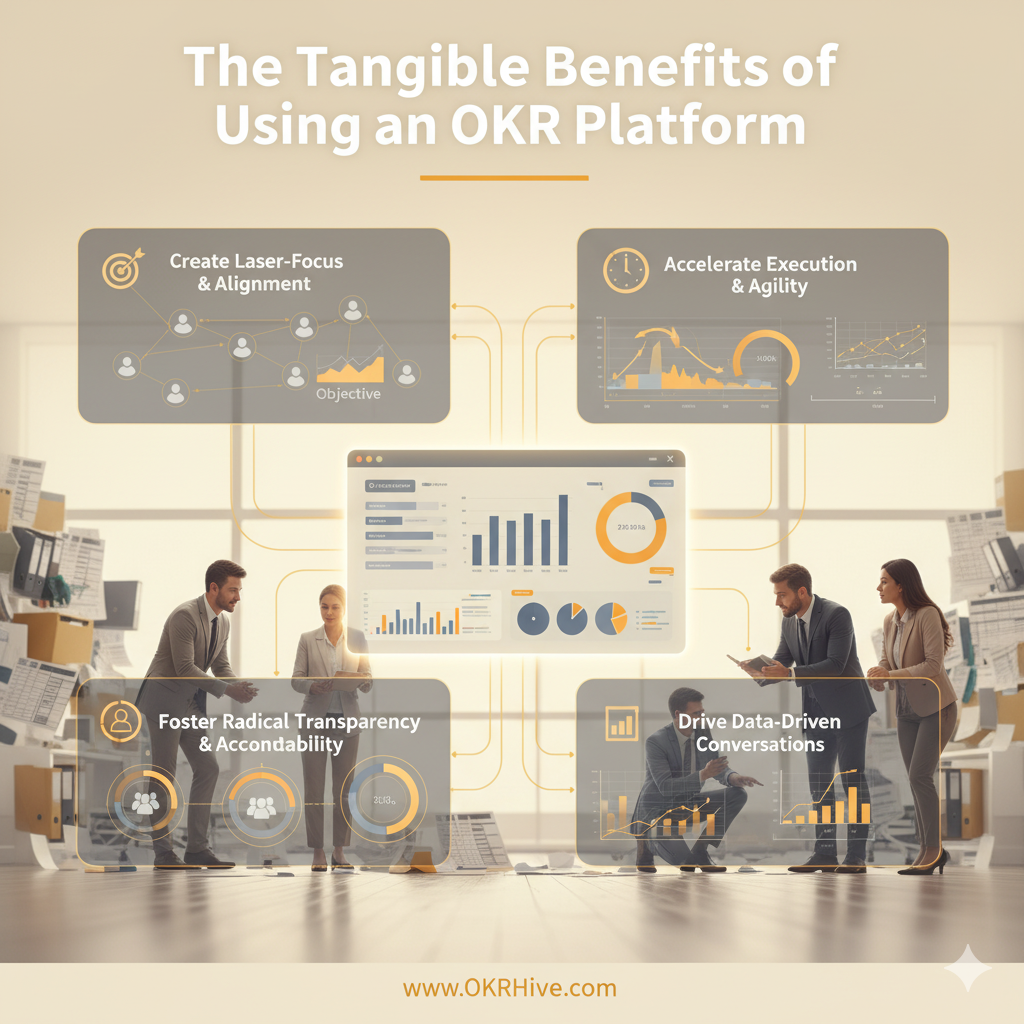
Tangible Benefits of Using an OKR Platform
1. Create Laser-Focus and Alignment
A top-tier system visually connects company goals to team and individual contributions. Everyone sees how their work drives the bigger picture. This eliminates wasted effort on low-impact projects. It ensures your entire organization is rowing in the same direction.
2. Accelerate Execution and Agility
Goals are not set in stone. Markets change. The right business goal management software allows for easy check-ins and updates. Teams can adapt their key results as new information arrives.
This builds agility into your company's DNA. You move from an annual planning cycle to a quarterly execution rhythm.
3. Foster Radical Transparency and Accountability
In a connected system, everyone's goals are visible. This builds a culture of ownership. There is no hiding. Teams can see dependencies and offer help. This is how the best OKR software improves cross-functional collaboration naturally.
4. Drive Data-Driven Conversations
Forget subjective performance reviews. With business goal management software, conversations are grounded in data. You discuss progress, blockers, and results. Not opinions. This makes performance reviews fairer and more productive.
Gallup links this clarity to results, finding that organizations with highly engaged employees show 21% greater profitability.
Ready to experience these benefits? See how OKR Hive can transform your goal-setting.
How to Choose the Right OKR Platform for Your Organization
This is the most critical decision you will make. The wrong tool will frustrate your team and kill your OKR program. The right one will fuel adoption and deliver a clear ROI.
Follow this strategic framework.
Step 1: Diagnose Your Company's Specific Needs
Before looking at any vendors, look inward. Ask these questions:
Company Size & Structure: Are you a 50-person startup or a 5,000-person enterprise? An enterprise OKR solution needs robust security, admin controls, and scalability that a small team does not.
Primary Goal: What is your main pain point? Is it strategic alignment? Employee engagement? Faster execution? Your answer will guide your feature priorities.
Tech Stack: What tools does your team already use? Your OKR software should integrate with Slack, Microsoft Teams, Jira, Salesforce, and other core systems.
Step 2: Evaluate Must-Have Features
The best OKR software balances simplicity with power. Here are the non-negotiable features to look for:
Intuitive User Interface: If the tool is confusing, people will not use it. It should feel as easy as using a social media app.
Robust Integration Capabilities: The platform should push and pull data from your existing tools. This embeds OKRs into daily work.
Visual Progress Tracking: At-a-glance dashboards with progress bars and color codes make status updates instant.
Flexible Permission Settings: Control who can see and edit what. This is crucial for larger organizations.
Comprehensive Reporting & Analytics: Leaders need insights into goal health and company-wide trends.
Step 3: Consider the Implementation and Support
How to implement an OKR platform in large organizations is a common challenge. The vendor's role is critical here.
Onboarding Process: Do they offer a structured rollout plan? Do they provide dedicated customer success managers?
Training Resources: Look for a rich library of tutorials, webinars, and documentation.
Customer Support: Test their support channels. Are they responsive and knowledgeable?
Step 4: Plan for Adoption and Change
A tool is only as good as its usage. The best OKR goal-setting tool in the world will fail without a plan for cultural adoption.
Executive Sponsorship: Leaders must not just approve the tool; they must actively use it.
Internal Champions: Identify and train advocates in each department to drive local adoption.
Communicate the "Why": Continuously remind teams how the platform makes their lives easier and work more meaningful.
Real-World Success Stories of OKR Adoption
Theory is good. Proof is better. Here are examples of companies using goal-setting systems successfully.
A Forbes Insights study highlights the urgency, noting that 72% of enterprise leaders cite "cross-functional collaboration" as critical, yet only 25% rate their organization's effectiveness as good.
Case Study 1: Tech Scale-Up Aligns for Hyper-Growth
A 400-person SaaS company was growing fast. But strategy was getting lost between departments. Engineering built features Marketing did not promote. Sales sold things Product had not prioritized.
They implemented a dedicated OKR framework software. For the first time, everyone could see the top-level quarterly objectives. Marketing linked their "Increase Qualified Leads" goal directly to the company's "Accelerate Revenue Growth" objective. Engineering could see how their "Improve Platform Stability" work supported the "Increase Customer Retention" company goal.
Result: Within two quarters, cross-functional disputes dropped. Feature release cycles accelerated by 30%. Everyone was focused on the metrics that mattered most.
Case Study 2: Large Enterprise Breaks Down Silos
A 10,000-person financial services firm suffered from deep departmental silos. The retail banking division had no visibility into the commercial banking division's goals. They were often competing for the same IT resources.
They deployed a robust enterprise OKR solution. Leadership set a top-level objective to "Enhance the Cross-Sell Ratio for Enterprise Clients." For the first time, leaders from retail, commercial, and wealth management could see each other's supporting key results.
This new transparency, powered by their performance alignment platform, allowed them to identify synergies instantly. They started collaborating on shared client plans instead of working in isolation.
Result: The company saw a 15% increase in cross-sell revenue within one year. The platform provided the visibility needed to act as one unified company.
Navigating Common Roadblocks in OKR Implementation
Even with the best tool, challenges will arise. Being prepared is half the battle.
Roadblock: "It's just another corporate process."
- Solution: Use the platform to celebrate wins publicly. When a team achieves a key result, highlight it in the tool and on company-wide calls. Show this is about recognition, not surveillance.
Roadblock: "Setting measurable key results is too hard."
- Solution: Leverage the training and templates within your OKR framework software. Many platforms offer examples from similar companies to spark ideas.
Roadblock: "We don't have time for weekly check-ins."
- Solution: Integrate OKR check-ins into existing stand-up meetings. The platform should make this quick—a 2-minute update, not a 30-minute discussion.
Why OKR Software is Essential for Performance Management in 2026
The world of work is changing. Remote and hybrid models are the new normal. Annual performance reviews are obsolete. Why OKR software is essential for performance management in 2026 is clear.
Modern performance management is continuous, flexible, and focused on growth. An OKR Platform is the engine for this model. It provides the ongoing feedback loop between managers and employees. It shifts the conversation from "What did you do last year?" to "What are we achieving together right now, and how can I help you?"
This is the future of work. And it is powered by the right OKR Platform.
Your Next Move Towards Strategic Clarity
Next Move Towards Strategic Clarity
Choosing an OKR Platform is a strategic investment in your company's future. It is the difference between hoping for growth and engineering it. The right platform will align your team, clarify your priorities, and accelerate your results.
Stop letting disconnected tools and messy spreadsheets hold you back. The path to flawless execution is clear.
Ready to see what a purpose-built OKR Platform can do for your organization?
[Book a Demo with Our Team] or [Start Your Free Trial Today]
We will give you a personalized tour of our OKR goal-setting tool and show you how it can be tailored to drive your unique business outcomes.
Frequently Asked Questions (FAQ)
How does an OKR Platform differ from basic project management software?
*While project tools manage tasks, this system connects daily work to strategic outcomes, ensuring company-wide alignment and measurable results.*
What should we look for in the best OKR software for a growing company?
*Focus on usability, integration with your current tools, and scalability. The best OKR software grows with you, avoiding a costly switch later.*
Is there a difference between an OKR goal-setting tool and a performance alignment platform?
They are closely related. An OKR goal-setting tool focuses on defining objectives and key results. A performance alignment platform often uses OKRs as its core method to ensure everyone's work contributes to top-level strategy.
We're a large company. What defines an enterprise OKR solution?
An enterprise OKR solution must have robust security, advanced admin controls, customizable reporting, and the ability to support a complex, multi-layered organizational structure.
How difficult is the typical OKR implementation process?
A successful OKR implementation is more about cultural change than technical setup. The right platform provides templates, training, and support to guide your rollout over a few weeks.


