
Your company is hemorrhaging $1.5 million in productivity for every 100 employees—and your executives are barely noticing.
While 85% of leadership teams dedicate less than one hour monthly to strategy execution, their employees waste nearly 20% of their time on work that doesn't advance company goals. This isn't just misalignment—it's the silent killer of growth.
This is where OKR software becomes your most critical investment. If you're relying on fragmented spreadsheets and repurposed CRM platforms to manage goals, you're not just inefficient, you're institutionalizing this waste.
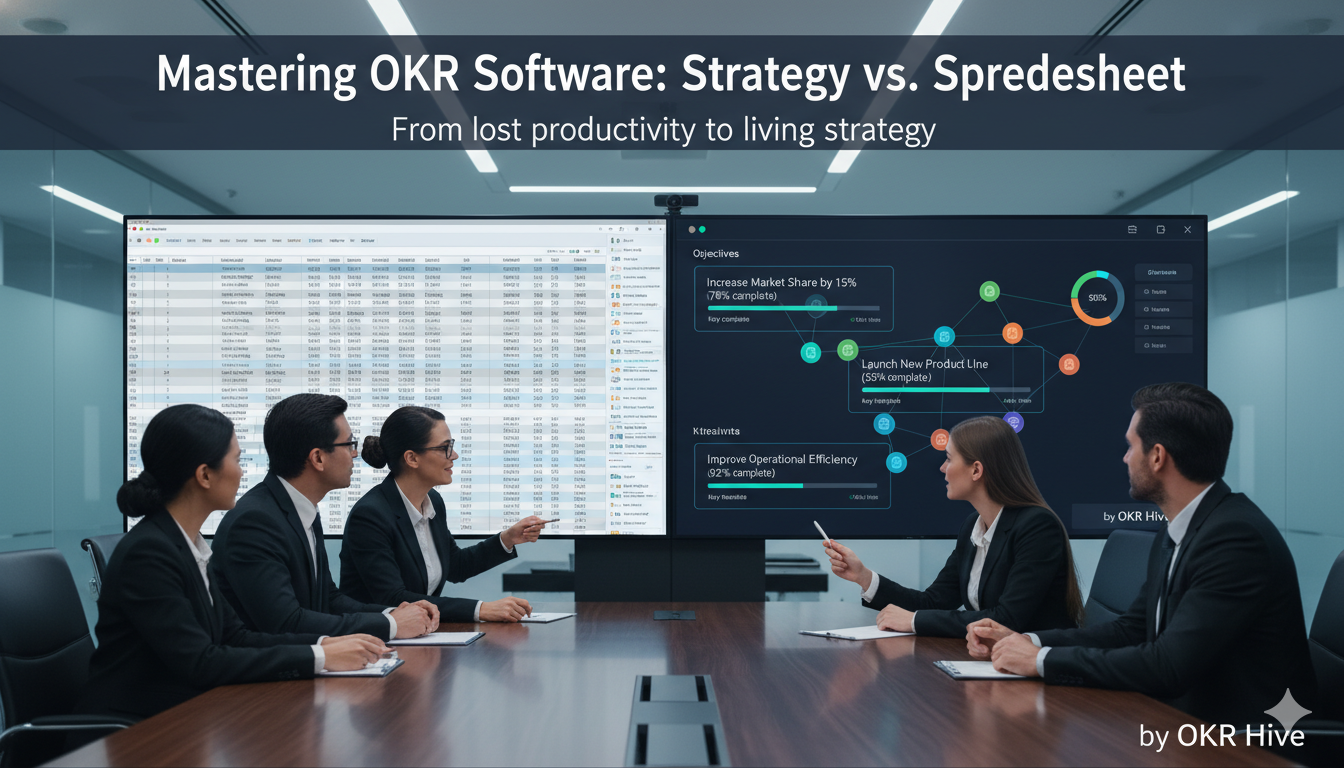
Mastering OKR Software: Strategy vs. Spreadsheet
The right OKR platform stops the bleeding by creating an undeniable line of sight between executive vision and daily execution. It transforms your strategy from something discussed occasionally in boardrooms to something lived daily by every team.
In this guide, we'll show you how to recapture that lost value by connecting what matters to what actually gets done.
The Silent Strategy Killer: Your Static Spreadsheet
Think of your company's strategy as a living, breathing roadmap. Now, imagine locking that roadmap in a vault after it's printed. That’s what happens when you manage goals in a spreadsheet.
Spreadsheets are museums for data static, isolated, and frozen in time. The moment you save the file, the information begins to decay. There's no live connection between the CEO's vision and the marketing team's daily tasks. This disconnect is the silent killer of even the most brilliant plans.
A dedicated Best OKR software platform acts as your central nervous system for goals. It brings your strategy out of the vault and into the daily workflow.
Imagine this: Your CEO sets an Objective to "Become the Market Leader in the Midwest." In a spreadsheet, that's a lonely line of text in a forgotten tab. In an OKR platform, it becomes a live mission.
The sales team can directly connect their goal to "Dominate Enterprise Sales in Chicago," and their progress automatically fuels the company-wide dashboard.
This is the difference between a document and a dynamic system. It transforms individual effort into a unified, visible force, ensuring every task across the organization pulls in the same direction.
OKR Software vs. CRM Platforms: Where Should You Manage Goals?
This is a common point of confusion. Let's clear it up.
Your CRM software is your system of record for customer interactions. It tracks leads, deals, and customer support tickets. It is exceptional for managing the what and who of your sales pipeline.
OKR tracking software, however, is your system of record for strategy and execution. It manages the why and how. It answers the question: "Are we all working on the right things to move the company forward?"
Think of it this way:
CRM Platform: Tracks the deal. Manages the sales process from lead to close. Your sales goal tracking software might live here to monitor quota attainment.
OKR Platform: Tracks the strategy behind the deals. Manages the objective to "Increase Enterprise Deal Size by 20%" by aligning marketing, product, and sales efforts.
You should not try to make your CRM platform your corporate goal management software. They serve different, but complementary, purposes. The best results come from integrating them.
How to Align OKR Software with CRM Data
The magic happens when your OKR tool talks to your CRM platform. This integration bridges the gap between strategy and execution.
For example, your sales team's Key Result in the OKR platform might be "Increase average contract value by 15%." This KR can be directly fed by data from your CRM software. The progress updates automatically, giving a real-time view of strategic performance.
This makes your OKR software the single source of truth for why you are pursuing a goal, and your CRM the source of truth for how you are achieving it in the market.
What to Look For in a Modern OKR Platform
Not all OKR software is created equal. The best platforms share a set of core features that drive adoption and success.
Intuitive Goal Setting and Linking The system should make it easy to create Objectives and measurable Key Results. More importantly, it must allow teams and individuals to link their OKRs to company goals. This creates the alignment that is the entire point of the methodology.
Real-Time Progress Tracking and Dashboards
Forget manual updates. Look for an OKR platform that integrates with tools like Jira, Salesforce, and Google Analytics. Progress should update automatically. A clear sales dashboard software view of goal health is essential for leaders and teams.
Transparency and Collaboration
A great OKR system breaks down departmental silos. Everyone should be able to see what everyone else is working on. This fosters collaboration, reduces duplicate work, and creates a culture of shared responsibility.
Robust Reporting and Analytics
You need to understand what’s working. Your OKR tracking software should provide powerful reports on goal completion rates, alignment strength, and team confidence. This data is gold for leadership teams.
A Focus on the "Why" The best tools are not just about tracking. They include features for writing great OKRs, providing context, and celebrating wins. They are built for people, not just for data.
From Chaos to Clarity: Your 4-Step OKR Launch Plan
Implementing OKRs doesn't need to be complicated. Our straightforward four-week plan transforms goal-setting from chaotic to clear.
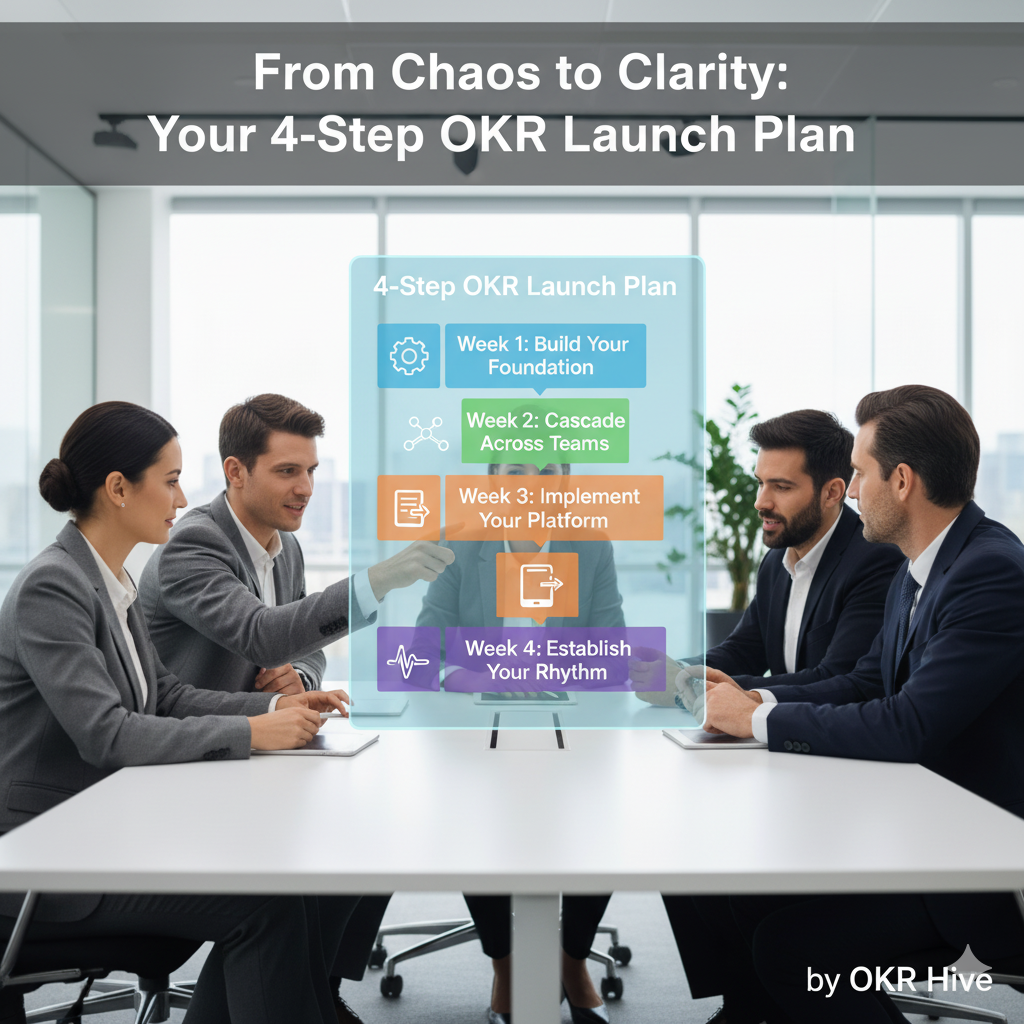
From Chaos to Clarity: Your 4-Step OKR Launch Plan
Week 1: Build Your Foundation
Start with leadership alignment. Define 3-5 company Objectives that are both ambitious and achievable. Establish measurable Key Results that create your strategic backbone. This ensures everyone starts from the same page.
Week 2: Cascade Across Teams
Now involve every department. Help teams create objectives that support company goals. Watch marketing align with product development. See sales connect with customer success. This creates powerful cross-functional alignment.
Week 3: Implement Your Platform
Choose intuitive OKR tracking software that fits your team's needs. Input all goals and connections. Provide simple training that emphasizes transparency. Make strategy visible to everyone in your organization.
Week 4: Establish Your Rhythm
Launch weekly check-ins lasting under 30 minutes. Focus on progress and blockers, not just metrics. Celebrate quick wins to build momentum. Create lasting habits of accountability and adaptation.
Within one month, you'll see dramatic improvements in focus and alignment. Remember: progress beats perfection. Start with one quarter, learn quickly, and refine your approach. The right OKR software makes this journey smooth and successful.
Finding the Best OKR Platform for Your Team's Needs
Your ideal OKR platform depends entirely on your company's unique context—its size, industry, and biggest challenges. A one-size-fits-all approach doesn't work for strategic goal management.
Choosing an OKR Tool for Small Businesses
Smaller teams thrive on agility and simplicity. Without a dedicated strategy team, the platform must be intuitive and easy to adopt. The goal is rapid alignment, not managing complex enterprise features.
Look for an Modern OKR software that requires minimal training. The best OKR tool for a small business provides a clear, visual path from company Objectives directly to daily tasks, making the connection between work and strategy undeniable for every team member.
Selecting a Goal-Setting System for Sales Teams
Sales teams operate within their CRM platform. Therefore, the best OKR system for them is one that integrates seamlessly with tools like Salesforce or HubSpot.
This specialized goal-setting software must translate high-level revenue targets into specific, measurable Key Results for the sales department. It acts as a strategic layer on top of existing sales dashboard software, answering the critical "why" behind the "what."
How this business goal tracking software improves performance is by creating profound clarity. When each salesperson sees how their quota ladders up to the company mission, their focus and motivation intensify, driving better results.
The Bottom Line: It’s About More Than Just Tracking
Choosing the right OKR platform is a strategic decision. It is not about buying another piece of employee performance tracking software. It is about investing in a system that makes your strategy visible, connected, and achievable.
The best OKR platform transforms your organization's approach to goal-setting. It replaces uncertainty with clarity. It turns individual effort into collective achievement. It moves your company from just being busy to being genuinely productive.
In the ongoing CRM platform vs. OKR tool comparison, the winner is always your company—when you use the right tool for the right job. Let your CRM manage your customers. Let your ambition drive your goals.
Frequently Asked Questions (FAQs)
We already use a CRM. Why do we need a separate platform?
Your CRM manages customer relationships and sales pipelines. A dedicated OKR software platform, however, is designed for company-wide strategic goal management. It provides the crucial "why" behind your sales activities, ensuring every team is aligned with the top-level business objectives, not just tracking tasks.
2How do we ensure company-wide adoption?
Secure executive sponsorship leaders must actively use the system. Train managers first as champions, then roll out to teams. Celebrate early wins publicly within the platform to demonstrate its value and build momentum.
Can this work for a non-profit or government agency?
Absolutely. The framework of Objectives and Key Results is universal. Whether your goal is to "Increase Fundraising by 20%" or "Improve Service Delivery Times," an OKR platform provides the focus and accountability needed for mission-critical outcomes.
What's the biggest implementation mistake?
Treating the tool as a simple tracking system instead of a catalyst for cultural change. Success requires a shift toward transparency, regular check-ins, and adaptability. The software enables this culture but doesn't create it automatically.
How often should we review OKRs?
OKRs are living goals. Teams should have brief weekly check-ins to discuss progress. Leadership should conduct formal reviews at least monthly. This rhythm, supported by your goal management platform, keeps everyone aligned and allows for quick strategic adjustments.


